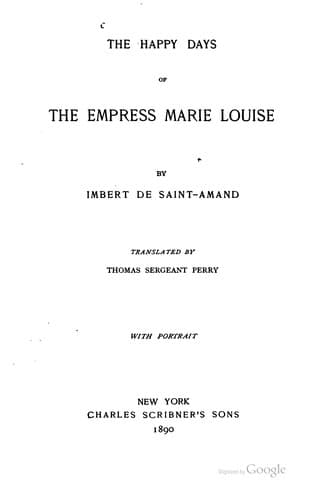
The Happy Days of the Empress Marie LouiseImbert de Saint-Amand
History
The Happy Days of the Empress Marie Louise
Imbert de Saint-Amand
Marie Louise, Empress, consort of Napoleon I, Emperor of the French, 1791-1847
Marie Louise did not have the character of her great-grandmother
Marie Thérèse, or that of her great-aunt Marie Antoinette. She rather
resembled the wife of Louis XIV. or that of Louis XV. She would have led
a calm, modest, harmless life, like those two queens, if her fate had
not placed her amid unforeseen and terrible events, the shock of which
she could not endure. In 1812 we see her a loving mother, a faithful
wife, a worthy sovereign. If Napoleon had adopted a less imprudent
policy, all that would have lasted. Doubtless that is what he said to
himself when, at Saint Helena, he impartially examined his career, and
he had no angry thought, no bitter word, for the woman who has been so
severely judged by others.
XXVI.
THE EMPRESS'S HOUSEHOLD.
We have just tried to draw a picture of the appearance and character of
Marie Louise in 1812, when at the summit of her fortune; let us turn our
attention to the organization of her household at this epoch, and to
the details of her daily life. Her first almoner was Count Ferdinand de
Rohan, formerly Archbishop of Cambrai; her knight-of-honor was the Count
of Beauharnais, who had held the same position to the Empress Josephine,
a relative of his. Napoleon had at first meant to appoint the Count of
Narbonne to this place, but Marie Louise had dissuaded him. M. Villemain
says in his _Life_ of M. de Narbonne: "The Empress Marie Louise,
generally so yielding to her husband, on this occasion manifested great
opposition. Whether through womanly kindness or through her pride as a
sovereign, possibly through some superstitious scruple as a second wife,
she insisted on the retention in this post of the Count of Beauharnais;
she was unwilling on any terms to seem to exclude, in the person of this
relative of Josephine, the first name of the Princess whom she succeeded
on the French throne. On the other hand, it is fair to suppose that in
the dashing and attractive Count of Narbonne she was willing to keep
away certain things which were unfamiliar and so alarming to her,
such as the lighter graces, the jesting spirit of the old court, and
doubtless too the melancholy presentiments attached, in her mind, to
everything that recalled Versailles and the daughters of Louis XV., who
had become the aunts of Marie Antoinette. In a word, Marie Louise, cold
and calm, was inflexible in her opposition to the choice which the
Emperor announced to her. He at once yielded the point, and smoothed
matters over by appointing M. de Narbonne one of his aides, an odd favor
for a man fifty-five years old, a relic of the former court, suddenly
made a member of the most warlike and most active staff in Europe." For
first equerry Marie Louise had Prince Aldobrandini, and for master of
ceremonies, the Count de Seyssel d'Aix.
Public-domain text, read in full here on John Shaqi.
Reviews
Reviews
No reviews yet
Be the first to share your thoughts on this work.
Elsewhere in the archive
Join the Discussion
Join the discussion
Sign in to leave a comment or review.
Sign InorCreate an account