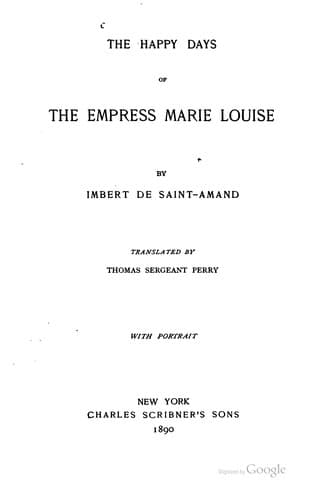
The Happy Days of the Empress Marie LouiseImbert de Saint-Amand
History
The Happy Days of the Empress Marie Louise
Imbert de Saint-Amand
Marie Louise, Empress, consort of Napoleon I, Emperor of the French, 1791-1847
honorable people, whose delicacy and uprightness were above suspicion,
and of women of the best reputation; he was a good judge, and he
demanded a great deal. This was undeniably true, and the exceptions were
very few: the way he chose his council and the officers attached to his
person, shows it. In corroboration I will quote first the Grand Marshal
Duroc with all the household of the palace, whose affairs were managed
more honestly and better than those of any private house that can be
named. As to the ladies of the court, it will be enough to name Madame
de Luçay, my mother-in-law, the Lady of the Bedchamber, and Madame de
Montesquiou, governess of the King of Rome, whom the Emperor chose when
my mother declined the position from ill-health. His confidence, when
once given, was unlimited."
The Countess of Montesquiou, the governess of the King of Rome, was
the wife of the Emperor's Grand Chamberlain. The Baron de Méneval thus
speaks of her: "Madame de Montesquiou, who was of high birth, received
the highest consideration and thoroughly deserved it. She was forty-six
years old when she was appointed governess of the Imperial children;
her reputation was above reproach. She was a woman of great piety, yet
indifferent to petty formalities; her manners had a noble simplicity,
her whole nature was dignified but benevolent, her character was firm,
and her principles were excellent. She combined all the qualities that
were required for the important position which the Emperor, of his
own choice, had given her." Madame Durand speaks as warmly about the
Countess of Montesquiou: "It would have been hard to make a better
choice. This lady, who belonged to an illustrious family, had received
an excellent education; to the manners of the best society she added a
piety too firmly fixed and too wise to run into bigotry. Her life had
been so well ordered that she escaped any breath of calumny. Some were
inclined to call her haughty, but this haughtiness was tempered by
politeness and the most gracious consideration for others. She took the
most tender and constant care of the young Prince, and there could be
nothing nobler and more generous than the devotion which led her later
to leave the country and her friends, to follow the lot of this young
Prince whose hopes had been destroyed. Her sole reward was bitter sorrow
and unjust persecution.
Public-domain text, read in full here on John Shaqi.
Reviews
Reviews
No reviews yet
Be the first to share your thoughts on this work.
Elsewhere in the archive
Join the Discussion
Join the discussion
Sign in to leave a comment or review.
Sign InorCreate an account