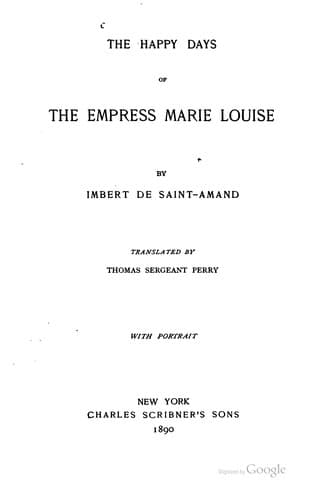
The Happy Days of the Empress Marie LouiseImbert de Saint-Amand
History
The Happy Days of the Empress Marie Louise
Imbert de Saint-Amand
Marie Louise, Empress, consort of Napoleon I, Emperor of the French, 1791-1847
"The Duchess of Montebello and the Countess of Montesquieu had little
sympathy for each other, but they never betrayed any coolness. Even had
they desired it, they would have been held in awe by fear of
Napoleon, who insisted on harmony in his court. Still, there could
be distinguished at the Tuileries two parties in occult opposition,
belonging respectively to the old and to the new nobility. At the head
of the first stood the Count and the Countess of Montesquieu; of the
second, the Duchess of Montebello, to whom the Empress's preference gave
great authority. Madame Durand says that all the influence which the
Grand Chamberlain and his wife, the governess of the King of Rome,
enjoyed was exercised in obtaining pardon, favors, pensions, and places
for the nobles, whether they had left France or not; they assured the
Emperor that this was the best way of attaching them to his person, of
making them love his government. They said this because they really
thought it; and since they believed that the destiny of France was
firmly fixed, they were anxious to secure for the ruler of this Empire
those men whom they regarded as its strongest support. Since he had seen
Madame de Montesquiou's unwearying devotion to his son, it was seldom
that he refused her whatever she asked."
The new nobility, which was jealous of the old, had a representative in
the Duchess of Montebello, who was very proud, and did not admit the
superiority of the old aristocracy to the illustrious plebeians,
who, like her husband, had no ancestors, but were destined to become
ancestors themselves. She thought that the title of Duke was not enough
for her valiant husband, and that the Emperor, in not making him a
prince like Davout, Masséna, and Berthier, had been unjust, and that
Marshal Lannes was of more account than all the dukes and marquises of
the Versailles court.
There was at court, between these two groups of the old and the new
nobility, a third party, the military party, headed by the Grand Marshal
of the Palace, Duroc, Duke of Frioul, who, seeing honor and glory only
in the career of a soldier, looked down on all other occupations. The
Emperor secretly favored him, but he nevertheless remained true to his
usual system of neutralizing all opinions, by trying to balance their
forces. Each one of the three rival parties kept an eye on the other
two, and thus everything of interest came to the Emperor's ears.
Public-domain text, read in full here on John Shaqi.
Reviews
Reviews
No reviews yet
Be the first to share your thoughts on this work.
Elsewhere in the archive
Join the Discussion
Join the discussion
Sign in to leave a comment or review.
Sign InorCreate an account