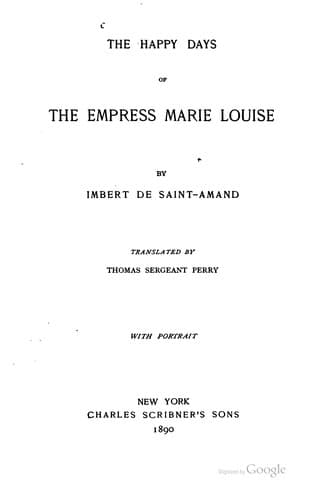
The Happy Days of the Empress Marie LouiseImbert de Saint-Amand
History
The Happy Days of the Empress Marie Louise
Imbert de Saint-Amand
Marie Louise, Empress, consort of Napoleon I, Emperor of the French, 1791-1847
The Emperor's intention in going to Dresden was to spend two or three
weeks there before taking command of his armies, and to dazzle all
Europe by the sumptuous court which he should hold in the Saxon capital.
For some weeks Marie Louise had been hoping to meet her father at
Dresden, and the thought filled her with joy. She had written to him,
March 15: "The Emperor sends all sorts of kind messages to you. He bids
me tell you also that if we have war, he will take me to Dresden, where
I shall spend two months, and where I hope soon to see you too. You
cannot imagine, dear father, the pleasure I take in this hope. I am sure
that you will not refuse me the great pleasure of bringing my dear mamma
and my brothers and sisters. But I beg of you, dear papa, don't say
anything about it, for nothing is decided." Marie Louise was at the
height of happiness when she reached Saxony. At that moment she was very
proud of being Napoleon's wife. She entered Dresden with him, May 16,
1812, at eleven in the evening, escorted by the King and Queen of
Saxony, who had gone to Freiberg to meet them.
The next morning at eight, Napoleon, who was staying in the grand
apartment of the royal castle, received the sovereign princes of
Saxe-Coburg, Saxe-Weimar, and Dessau, as well as the high officials of
the Saxon court. The King of Westphalia and the Grand Duke of Würzburg
arrived in the course of the day, and at once presented their respects.
At one o'clock in the afternoon of the 18th the Emperor and Empress of
Austria arrived in Dresden. "What a moment for Marie Louise!" writes
Madame Durand. "She found herself once more in her father's arms, and
appeared before the dazzled eyes of her family, the happiest of wives,
the first of sovereigns! Her August father could not hide his emotion.
He tenderly kissed his son-in-law, and recognizing the claims he had
upon his heart, told him more than once that he could count on him
and on Austria for the triumph of the common cause." Possibly these
assurances were not perfectly sincere, but Napoleon believed in them, or
pretended to believe in them. As for Marie Louise, she never interfered
in politics, and gave herself up to family joys.
Public-domain text, read in full here on John Shaqi.
Reviews
Reviews
No reviews yet
Be the first to share your thoughts on this work.
Elsewhere in the archive
Join the Discussion
Join the discussion
Sign in to leave a comment or review.
Sign InorCreate an account