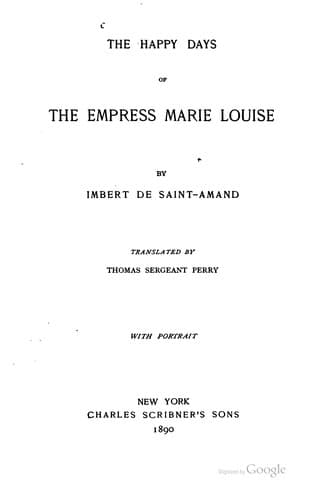
The Happy Days of the Empress Marie LouiseImbert de Saint-Amand
History
The Happy Days of the Empress Marie Louise
Imbert de Saint-Amand
Marie Louise, Empress, consort of Napoleon I, Emperor of the French, 1791-1847
The period of Napoleon's stay at Dresden was the culmination of his
power. Possibly no mortal had ever attained so high a position as this
new Agamemnon. "It is at Dresden," says Chateaubriand, "that he united
the separate parts of the Confederation of the Rhine, and for the first
and last time set in motion this machine of his own creation. Among the
exiled masterpieces of painting which sadly missed the Italian sun,
there took place the meeting of Napoleon and Marie Louise with a crowd
of sovereigns, great and small. These sovereigns tried to make out of
their different courts subordinate circles of the first court, and
rivalled with one another in vassalage. One wanted to be the cup-bearer
of the ensign of Brienne; another, his butler. Charlemagne's history
was put under contribution by the erudition of the German chancellor's
officers. The higher they were, the more eager their demands. As
Bonaparte said in Las Cases, a lady of the Montmorencys would have
hastened to undo the Empress's shoes." The monarchs were more like
Napoleon's courtiers than his equals. Princes and private citizens, rich
and poor, nobles and plebeians, friends and enemies, crowded to get a
look at him. Night and day there was an immense throng gazing at the
doors and windows of the palace in which lodged the predestined being,
in hope of being able to say, "I have seen him." The French waited on
him with idolatry. The Germans had a complex feeling about him, in which
admiration was stronger than hate.
General de Ségur, who was at Dresden with Napoleon, represents him
as moderate and even eager to please, but with visible effort and
manifestations of the fatigue which he experienced. As to the German
princes, their attitude, their words, even the tone of their voice,
showed the ascendancy he exercised over them. They were all there solely
on his account. They scarcely ventured to discuss anything, being always
ready to recognize his superiority of which he was himself only too
conscious. "His reception," adds the General, "presented a remarkable
sight. Sovereign princes flocked thither to await an audience of the
Conqueror of Europe; they so crowded his officers, that these last often
had to remind one another to take care not to offend these new courtiers
who were crowding among them. Napoleon's presence thus removed the
differences, for he was as much their chief as he was ours. This common
dependence seemed to level everything about him. Then possibly the
ill-concealed military pride of many French generals offended these
princes, when the former seemed to think that they were elevated to
royal rank; for whatever the dignity and position of the conquered, the
conqueror is his equal."
Public-domain text, read in full here on John Shaqi.
Reviews
Reviews
No reviews yet
Be the first to share your thoughts on this work.
Elsewhere in the archive
Join the Discussion
Join the discussion
Sign in to leave a comment or review.
Sign InorCreate an account