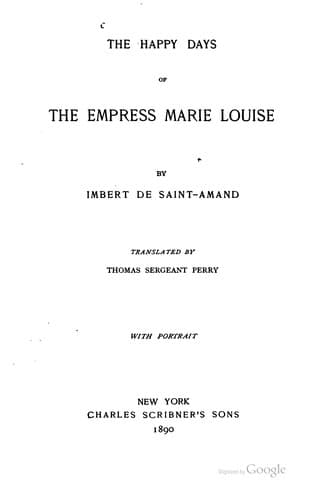
The Happy Days of the Empress Marie LouiseImbert de Saint-Amand
History
The Happy Days of the Empress Marie Louise
Imbert de Saint-Amand
Marie Louise, Empress, consort of Napoleon I, Emperor of the French, 1791-1847
May 18, the day of the arrival of the Emperor and the Empress of
Austria, it was the King of Saxony who gave a dinner to his guests; but
on the other days it was Napoleon who assumed the duties of hospitality,
as if he had been at home in Dresden. He wanted to receive, not to be
received. The sovereigns ate at his table, and it was he who fixed the
hours and all the details of etiquette. Since he was unwilling that his
stay should inconvenience the King of Saxony, who was not rich, he was
preceded and followed by his household, which was supplied with
everything necessary for a magnificent representation. Part of the
handsome vermilion table service presented to him by the city of Paris,
on the occasion of his marriage, had been carried to Dresden, and there
was all the luxury of the Tuileries.
At Saint Helena the beaten conqueror recalled the memory of his past
splendors with a certain satisfaction. "The interview at Dresden," he
said in his Memorial, "was the moment of Napoleon's highest power. Then
he appeared as the king of kings. He was compelled to point out that
some attention should be paid to his father-in-law, the Emperor of
Austria. Neither this monarch nor the King of Prussia had his household
with him; nor did Alexander at Tilsit or Erfurt. There, as at Dresden,
they ate at Napoleon's table. These courts, the Emperor used to say,
were mean and middle-class; it was he who arranged the etiquette and
set the tone. He invited Francis to visit him and dazzled him with his
splendor. Napoleon's luxury and magnificence must have made him seem
like an Asiatic satrap. There, as at Tilsit, he covered with diamonds
every one who came near him." He had brought after him the best actors
of the Théâtre Français, and, as at Erfurt, Talma played before a pit
full of kings.
What were the real feelings of these princes, who were so obsequious to
Napoleon? The King of Saxony, the patriarch of these monarchs, was
a frank, loyal man, of a keen sense of honor, and he was thoroughly
sincere in the devotion he professed to the Emperor, to whom he thought
he owed a great debt. Napoleon, who was very fond of this king, would
have no other guards at Dresden than the Saxon soldiers. Even after
Leipsic he retained a pleasant memory of them, and at Saint Helena he
said to those who charged him with excessive confidence in them, "I was
then in so kind a family, with such good people, that there was no risk;
every one loved me, and even now I am sure that the King of Saxony says
every day a _Pater_ and an _Ave_ for me."
Public-domain text, read in full here on John Shaqi.
Reviews
Reviews
No reviews yet
Be the first to share your thoughts on this work.
Elsewhere in the archive
Join the Discussion
Join the discussion
Sign in to leave a comment or review.
Sign InorCreate an account