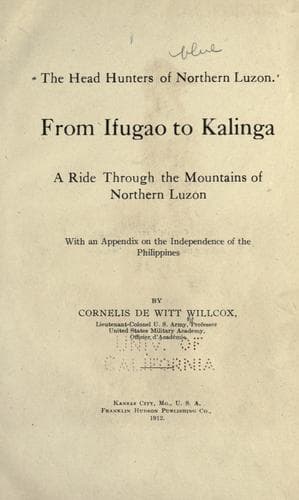
The Head Hunters of Northern LuzonWillcox, Cornélis De Witt
History
The Head Hunters of Northern Luzon
Willcox, Cornélis De Witt
Igorot (Philippine people); Luzon (Philippines) -- Description and travel
Of this, no better illustration can be given here than the error
committed when it is asserted that we, one people, are holding another
people, the Filipino, in subjection. As a matter of fact, there is no
Filipino people. A certain number of persons, about eight millions,
inhabit, the Philippine Archipelago, but it is no more correct to call
these one people than it is to call the Europeans one people, because
they happen to inhabit the European continent. It is well to keep
this point in mind, because, unless a grave error is here committed,
the impression prevails that it is one single, homogeneous people
whom we are unjustly depriving of independence. At any rate, if not
categorically expressed, the connotation of the idea of homogeneity
exists. How far this is from the truth is so evident to any person
having the slightest real acquaintance with the Philippines, that
it would hardly be worth while to dwell upon the matter here, were
it not for the ignorance of our people at large. It is convenient
to speak of the Filipino people, just as it is convenient to speak
of the Danish people, or of the English; but whereas, when we say
"Danish" or "English" we mean one definite thing that exists as such,
when we say "Filipino" we should understand that the term stands
for a relatively great number of very different things. For example,
confining ourselves for the moment to the Christianized tribes, it
may be asserted that the inhabitants of the great Cagayan Valley, the
tobacco-growing country, are at least as different from those of the
Visayas, the great middle group of Islands, as are the Italians from
the Spanish. Precisely similar differences, increasing, roughly, with
the difference of latitude, may be drawn almost at random between any
other pairs of the elements constituting the Filipino population. The
Ilokanos, to give only one more illustration, have almost nothing more,
in common with the Bicols than the fact that they both probably come
from the same original stock, just as the English and the Germans have
the same ancestors. All these subdivisions speak different languages,
and the vast majority do not speak Spanish at all.
Public-domain text, read in full here on John Shaqi.
Reviews
Reviews
No reviews yet
Be the first to share your thoughts on this work.
Elsewhere in the archive
Join the Discussion
Join the discussion
Sign in to leave a comment or review.
Sign InorCreate an account