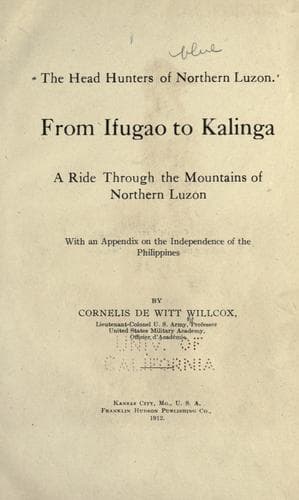
The Head Hunters of Northern LuzonWillcox, Cornélis De Witt
History
The Head Hunters of Northern Luzon
Willcox, Cornélis De Witt
Igorot (Philippine people); Luzon (Philippines) -- Description and travel
But this is not all. The Filipino peoples are divided into two
great classes, the Christian and the non-Christian. Now, these
non-Christians number over a million, and are themselves broken up into
many subdivisions, not only differing in language, customs, habits and
traditions, but until very recently bitterly hostile to one another,
and so low in the scale of political development that, unlike our
own Indians, they have never risen to any conception of even tribal
government or organization. Moreover, in Moroland, in the great island
of Mindanao with its neighbors, the situation is further complicated by
the fact that the dominant elements are Mohammedan. Over most of these
non-Christians the Spaniards had not even the shadow of control. The
appellation "Filipino people" is therefore wholly erroneous; more
than that, it is even dangerously fallacious, in that its use blinds
or tends to blind our own people to the real conditions existing in
the Archipelago. It is correct to speak of the Filipino _peoples_,
because this expression is, geographically, accurately descriptive;
but it is absolutely misleading to speak of the Filipino _people_,
because of the false political idea involved and conveyed by the use
of the singular number. Similarly, there is no objection to the term
"Filipino" or "Filipinos," so long as we understand it to mean merely
an inhabitant or the inhabitants of the Philippine Archipelago,
more narrowly the Christianized inhabitant or inhabitants; but it
is distinctly wrong to give to the term a political or national
color. It may be remarked now that the divisions, both Christian and
non-Christian, of which we have been speaking, determined as they are
by natural conditions, are likely to survive for many generations to
come. At any rate, the fact that many, and those the most important,
constituent elements of the proposed independent government are widely
separated by the seas, and that even those situated on the same islands
are confined by mountain ranges hitherto extremely difficult to cross,
makes it plain that the homogeneity necessary to the formation and
permanency of a strong government will be hard to secure, or, if ever
secured, to maintain.
When, therefore, it is proposed to grant independence to the
Philippine Islands, let it be recollected that this grant is to
be made not to a single homogeneous people, of one speech, of one
religion, of one state of civilization, of one degree of social and
political development, but to an aggregation of peoples, of different
speech, of different religions, of widely varying states of social
and political development, of little or no communication with one
another--to an aggregation, in short, whose elements, before 1898,
had had but one bond, the involuntary bond of inherited subjection
to Spanish authority, and all of which to-day are distinguished by
the characteristic trait of the Oriental, absence of the quality
of sympathy.
IV.
Public-domain text, read in full here on John Shaqi.
Reviews
Reviews
No reviews yet
Be the first to share your thoughts on this work.
Elsewhere in the archive
Join the Discussion
Join the discussion
Sign in to leave a comment or review.
Sign InorCreate an account