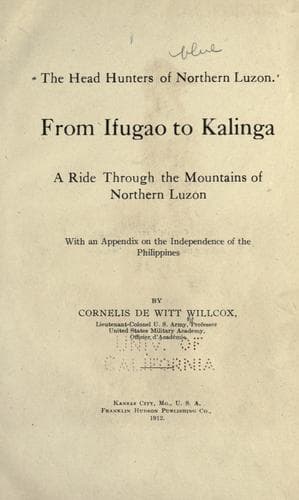
The Head Hunters of Northern LuzonWillcox, Cornélis De Witt
History
The Head Hunters of Northern Luzon
Willcox, Cornélis De Witt
Igorot (Philippine people); Luzon (Philippines) -- Description and travel
Now, it is a fact that the chief demand for independence comes from
the Tagálogs, the subdivision or tribe of the Filipinos (we are using
the word here and elsewhere as a convenience merely) inhabiting Manila
and the adjacent provinces. We speak in all kindliness when we say that
they are distinguished by a certain restlessness of disposition, by a
considerable degree of vanity. They are not so given to labor as some
others--for example, the Ilokanos, to whom they are measurably inferior
in point of trustworthiness. More numerous than any other tribe except
the Visayans, they are also wealthier and better educated. Some of
them have therefore earned and achieved distinction, but these are
exceptions, for in general they are characterized by volatility and
superficiality. They are more mixed in blood than other tribes. It is
not without significance that it was these same Tagálogs who organized
in the past the chief insurrections against the domination of Spain,
principally, as is well known, because of the misrule of the friars. It
is also a fact that the farther one removes from Manila the feebler
becomes the cry for independence. If we consider the condition of the
loudest supporters of the movement, we find them all, or nearly all,
to be politicians, _políticos_. Some of these politicians are not
Tagálogs--for example, Señor Osmeña, the Speaker of the Assembly,
is a Visayan; so that it would perhaps be more accurate to say
of the entire propaganda that it is an affair of the politicians,
supported chiefly by Tagálogs. In other words, it is worth while to
ask ourselves if the demand for independence be real, arising out
of the necessities of the people, or artificial, exploited by the
politicians for ends not unfamiliar to us here in the States. It is
useless to appeal for a decision to public opinion in the Archipelago,
that shall include the whole population, for no such public opinion
exists or can exist. And if it be argued that lack of public opinion
is no disproof of the existence of a real desire for independence, the
rejoinder springs at once to the tongue, that independence would be
a sham where public opinion is impossible. There is cause to believe
that the true aspect of the case is to be found in a remark made
by a young Tagalog (to Mr. Taft himself, if we recollect aright),
that there was no reason why independence should not be established
at once, seeing that the two things needed already existed in the
Philippines, to-wit, the governed in the shape of the peasantry of
the fields, and the governors among the _gente fina,_ the _gente
ilustrada_ (the superior classes) of Manila. However this may be,
a native newspaper of Manila, distinguished by its hostility to all
things American, by its insistent demand for independence, did not
hesitate to accuse the wealthy Filipino class of being "refractory
to the spirit of association," of being "egotistical and disdainful
Public-domain text, read in full here on John Shaqi.
Reviews
Reviews
No reviews yet
Be the first to share your thoughts on this work.
Elsewhere in the archive
Join the Discussion
Join the discussion
Sign in to leave a comment or review.
Sign InorCreate an account