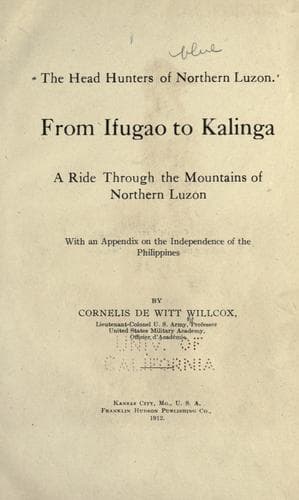
The Head Hunters of Northern LuzonWillcox, Cornélis De Witt
History
The Head Hunters of Northern Luzon
Willcox, Cornélis De Witt
Igorot (Philippine people); Luzon (Philippines) -- Description and travel
toward the middle and lower classes," and of refusing "to join their
interests with those of the lower classes." [53]
We do not go so far as do some, and believe that the whole agitation
is but a conspiracy to place the destinies of the Islands in the hands
of an oligarchy. But, in all probability, a Tagálog oligarchy would
be formed; for the capital, Manila, is Tagálog, the adjacent provinces
are Tagálog, the wealthy class of the Islands on the whole is Tagálog,
and there is no middle class anywhere. The mere fact that the capital
is situated in the Tagálog provinces would perhaps alone determine
the issue, apart from the fact that the Tagálogs are the dominant
element, of the native population. Before granting independence,
therefore, we should be reasonably sure that we are not in reality
placing supreme control in the hands of a few.
But let us suppose that in fact the populations of the Archipelago were
quite generally to ask for independence. We must again ask ourselves,
How genuine or real would this demand be? It is not very difficult to
answer this question. The Filipino is most easily led and influenced;
indeed, it is to be doubted if anywhere else in the world a being
can be found more easily led and influenced. [54] For example, it is
relatively not an uncommon thing, certainly in the Tagálog provinces,
for a man having a grudge against a neighbor to invite three or
four friends to join him in boloing his enemy. The invitation is
frequently accepted, although the guests may themselves have nothing
whatever against the victim-to-be. Early in 1909, a miscreant who had
been parading himself in women's clothes as a female Jesus Christ,
upon exposure by a native doctor, out of revenge got together a band
of nineteen men, and with their help proceeded to cut the doctor to
pieces. This occurred within a day's march of Manila. The example just
given suggests another Filipino trait, the readiness with which the
more ignorant will swallow any and all religious nostrums, and form
absurd sects, usually for the financial or other material benefit of
their leaders. In yet another case, a murderous bandit [55] of Tayabas
Province, a Tagálog province, whom we caught and very properly hanged,
used to promise as a reward for any deed of special villainy in which
he might be interested, a bit of _independencia_ (independence),
and then would show a box with the word painted on it, declaring that
it contained a supply sent down to him from Manila. He never failed
to find men to do his will. Our purpose in citing these examples,
whose number might be indefinitely multiplied, is not to show that
the poor, ignorant Filipino is especially criminal of disposition,
but to point out the ease with which he can be led by other men. If,
under evil influence, he will altruistically, as it were, consent to
almost any crime, obviously he can be induced to consent to almost
anything else. His consent or acquiescence can not be taken to indicate
Public-domain text, read in full here on John Shaqi.
Reviews
Reviews
No reviews yet
Be the first to share your thoughts on this work.
Elsewhere in the archive
Join the Discussion
Join the discussion
Sign in to leave a comment or review.
Sign InorCreate an account