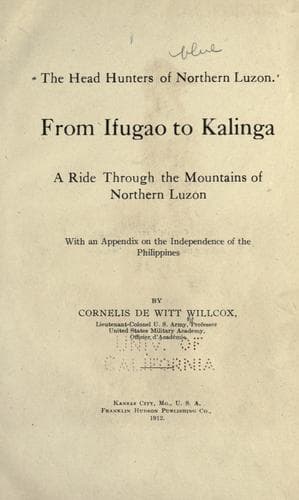
The Head Hunters of Northern LuzonWillcox, Cornélis De Witt
History
The Head Hunters of Northern Luzon
Willcox, Cornélis De Witt
Igorot (Philippine people); Luzon (Philippines) -- Description and travel
Before beginning the business of the day we walked about the village
and examined one or two houses. These are all of one room, entered
by a ladder drawn up at night, and set up on stout posts seven or
eight feet high; the roof is thatched, and the walls, made of wattle
_(suali)_, flare out from the base determined by the tops of the
posts. In cutting the posts down to suitable size (say 10 inches in
diameter), a flange, or collar, is left near the top to keep rats
out; chicken-coops hang around, and formerly human skulls, too,
were set about. But the Ifugaos, thanks to Gallman, as already said,
have abandoned head-hunting, and the skulls in hand, if kept at all,
are now hidden inside their owner's houses, their places being taken
by carabao heads and horns. One house had a _tahibi_, or rest-couch;
only rich people can own these, cut out as they are of a single log,
in longitudinal cross-section like an inverted and very flat V with
suitable head- and foot-supports. The notable who wishes to own one
of these luxurious couches gets his friends to cut down the tree
(which is necessarily of very large size), to haul the log, and to
carve out the couch, feeding them the while. Considering the lack
of tools, trails, and animals, the labor must be incredible and the
cost enormous. However, wealth will have its way in Kiangan as well
as in Paris.
By the time we had done the village, the hour of business had come,
and we moved up to the little parade in front of the _cuartel_, where
an enormous crowd had already assembled. As at Campote, so here, and
for the same reasons, very few old women were present, but about as
many young ones and children as there were men. Our approach was the
signal for the dancing to begin, and once begun, it lasted all day,
the _gansas_ never ceasing their invitation. Apparently anybody could
join in, and many did, informal circles being formed here and there,
for the Ifugaos, like all the other highlanders, dance around in a
circle. Both men and women took part, eyes on a point of the ground
a yard or so ahead, the knees a little bent, left foot in front, body
slightly forward on the hips, left arm out in front, hand upstretched
with fingers joined, right arm akimbo, with hand behind right hip. The
musicians kneel, stick the forked-stick handle of the _gansa_ in their
gee-strings, with the _gansa_ convex side up on their thighs, and
use both hands, the right sounding the note with a downward stroke,
the left serving to damp the sound. The step is a very dignified,
slow shuffle, accompanied by slow turns and twists of the left hand,
and a peculiar and rapid up-and-down motion of the right.
True to what had been said the day before, a particularly large circle
was formed, and Cootes and I were invited to join, which we did; if
any conclusion may be drawn from the applause we got (for the Ifugaos
clap hands), why, modesty apart, we upheld the honor of the Service.
Public-domain text, read in full here on John Shaqi.
Reviews
Reviews
No reviews yet
Be the first to share your thoughts on this work.
Join the Discussion
Join the discussion
Sign in to leave a comment or review.
Sign InorCreate an account