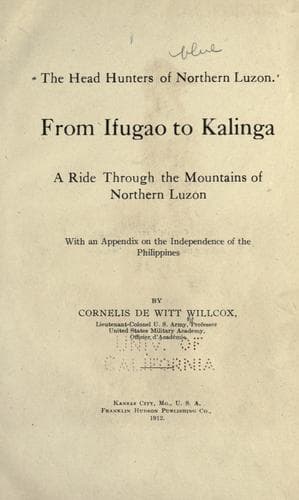
The Head Hunters of Northern LuzonWillcox, Cornélis De Witt
History
The Head Hunters of Northern Luzon
Willcox, Cornélis De Witt
Igorot (Philippine people); Luzon (Philippines) -- Description and travel
The multitude had now begun to disperse, for the sun's rays were
growing level, and the day was over. We were glad ourselves to
find our quarters, for we had had some ten hours of _gansa_-beating,
dancing, and all the rest of it: the _cañao_ had been a great success,
and, although _bubud_ had passed vigorously, the people had made no
trouble. We wound up with a little bridge, and there was, as there
always is, some business to be dispatched before turning in. But
we were all soon sound asleep, for next morning we had to be up at
four. [27]
CHAPTER XIV
Barton's account of a native funeral.
Mr. Barton, already mentioned as in residence at Kiangan as local
Superintendent of Schools, went out to see the funeral of the
Constabulary private killed on the morning of the 2d. He was strongly
advised not to go, because these highlanders resent more or less the
presence of strangers at their funeral ceremonies. But this made him
only the more eager, as very few Americans, or any others for that
matter, have ever been present on these occasions.
Passing through Manila a month or two later, he very kindly dictated
for me an account of what he saw, and I give it here, with his
permission, in his own words:
The Funeral of Aliguyen.
"On the third day after the soldier was killed, the principal funeral
ceremonies took place. To these ceremonies came a great number of
people from their various _rancherías_, the party from each _ranchería_
being led by the relatives of the soldier, some of them very distant
relatives.
"Aliguyen, the dead soldier, lived in the _ranchería_ of Nagukaran,
a _ranchería_ until quite recently very unfriendly to Kiangan, where
I live. Aliguyen, however, had some kin in Kiangan, and this kin,
together with their friends, went to the funeral. Their shields,
as well as the shields of all who attended, were painted with white
markings, taking some the form of men, some of lizards, some were
zig-zags. All men who attended had a head-dress made of the leaf
petiole of the betel tree and the red leaves of the dongola plant. To
these leaves were attached pendant white feathers. Everybody was
dressed in his best clout, and the women in their best loin-cloths
and in all their finery of gold beads and agate necklaces.
Public-domain text, read in full here on John Shaqi.
Reviews
Reviews
No reviews yet
Be the first to share your thoughts on this work.
Join the Discussion
Join the discussion
Sign in to leave a comment or review.
Sign InorCreate an account