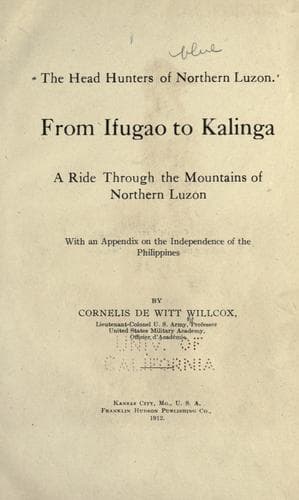
The Head Hunters of Northern LuzonWillcox, Cornélis De Witt
History
The Head Hunters of Northern Luzon
Willcox, Cornélis De Witt
Igorot (Philippine people); Luzon (Philippines) -- Description and travel
We had hardly dismounted before the dancing began, in general against
the sun, as elsewhere. Each _ranchería_ of the many present had its
dancers, and all made a display. One event, if the sporting term be
permissible, seemed to be a sort of "follow-my-leader"; the motions,
however, being confined to the circle, across which the file would go
from time to time, thus differing from any other dance seen. In some
cases, the step was bold and lively; in others, slow and stately, with
arms outstretched. The _gansa_ music was not nearly so well marked as
that of the Ifugaos; it seemed to lack definition (an opinion advanced
with some hesitation, and which a professional musician might not
agree with). Sometimes women only appeared; in fact, up here the
sexes did not mix in the dance. If we had remained longer in this
part of the country, perhaps the differences and characteristics of
this expression of native genius would have stood out more clearly;
but in our short time, with so much dancing going on, impressions
necessarily overlapped. And, in any case, shortly after our arrival,
night fell, putting an end to the show, and we betook ourselves
to our quarters; Captain Harris, of the local Constabulary forces,
most kindly receiving some of us in his house.
_Kalinga_ is neither a race nor a tribe name, but a word meaning
"enemy" or "outlaw," as though the hand of the people that bear
it had been against everybody's else. These people have been great
head-hunters, and have not yet entirely abandoned the practice, though
it is steadily diminishing. It should be recollected, however, that
it is only within the last three or four years that we have had any
relations with them, Mr. Worcester's first visit to Lubuagan having
occurred in 1907. On this occasion, immediately on arriving, he was
shut up with his party in a house; and all night a lively debate went
on outside as to whether the next morning his head should be taken or
not, his native interpreter informing him of the progress of opinion
as the night wore on.
In some respects these Kalingas differed from the tribes already
visited. Their superior height has already been noted. It may be noted
further that they are sloe-eyed, and their eyes are wide apart. It
is said that they have an infusion of Moro blood, brought in, many
years ago, by exiles from Moroland turned loose on the north coast of
Luzon by the Spaniards, with the expectation that the local tribes
would kill them; instead, they intermarried. Among themselves they
call their important men _dato_, a Moro title, and their Moro dress
has already been mentioned. They will not marry outside of their own
blood, and their women, so we were told, would not look at a white man.
Public-domain text, read in full here on John Shaqi.
Reviews
Reviews
No reviews yet
Be the first to share your thoughts on this work.
Elsewhere in the archive
Join the Discussion
Join the discussion
Sign in to leave a comment or review.
Sign InorCreate an account