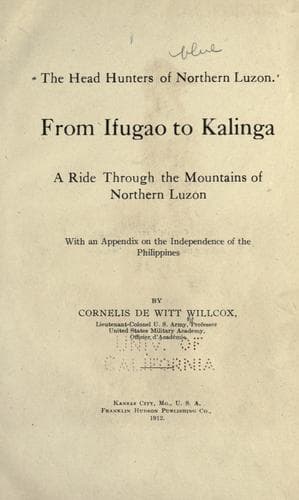
The Head Hunters of Northern LuzonWillcox, Cornélis De Witt
History
The Head Hunters of Northern Luzon
Willcox, Cornélis De Witt
Igorot (Philippine people); Luzon (Philippines) -- Description and travel
Lubuagan itself is extremely well situated on a gigantic terrace-like
slope, as though, as at Kiangan, an avalanche of earth had burst
through the rim of encompassing mountains. Here live the Governor of
the province and the inspector of Constabulary with a detachment; their
houses, with the _cuartel_ and public offices, are disposed around a
sort of parade, divided into an upper and a lower terrace. Aguinaldo
marched through the place during his flight, and left behind seventeen
of his men, sick and wounded. He had no sooner gone than these were
all taken out and beheaded. The native town lies above and just back
of the parade, with its houses running well up on the slopes. These
are, everywhere possible, terraced for rice, and so successfully
that two crops are made every year, as against only one at Bontok
and elsewhere. It follows that the Kalingas have more to eat than
their relatives to the south, and that is perhaps one reason of their
greater stature.
The morning of the 12th, our one full day at Lubuagan, broke clear,
bright, and hot, and so the day remained. Events during the next few
hours had no particular axis. We looked on mostly, though, of course,
here as elsewhere, business there was to be dispatched. The upper
terrace was the scene of crowded activity, being packed with people
from sunrise to sunset. Dancing went on the whole day; the sound
of the _gansa_ never ceased. A particularly interesting dance was
that of a number of little girls, eight or ten years of age, who went
through their steps with the greatest seriousness and dignity, a very
pretty sight. In yet another the performers, nine all told, grown men,
attracted attention from the fact that the handles of their _gansas_
were human lower jaws, apparently new, in the teeth of two of which
gold fillings glistened. The Ifugaos, who, it will be recollected,
had accompanied us from Banawe, also danced, their steps, motions,
and music forming a sharp contrast. This dance over, Comhit could
not restrain himself, but made a speech, in which he declared that
"These people up here, the Kalingas, are very good people indeed,
but not so good as the Ifugaos." Fortunately, only his own people
understood him. He had noticed on the way that the people we passed
offered nothing to drink to the traveller, and had commented freely to
Gallman on this lack of hospitality, so different from his country's
habits. We had nothing to complain of, however, on this score at
Lubuagan, for _basi_ circulated freely the whole day, being passed
along sometimes in a tin cup, at others in a bamboo; everybody drank
out of one and the same vessel. On the whole, this _basi_ was poor
stuff, not nearly so good as _bubud_. Harris told me after the day
was over, and we had taken innumerable tastes, at least, of the brew
(for one must drink when it is passed), that in preparing _basi_ a
dog's heart, [40] cut up into bits, is added to the fermenting liquid
to give it body.
Public-domain text, read in full here on John Shaqi.
Reviews
Reviews
No reviews yet
Be the first to share your thoughts on this work.
Elsewhere in the archive
Join the Discussion
Join the discussion
Sign in to leave a comment or review.
Sign InorCreate an account