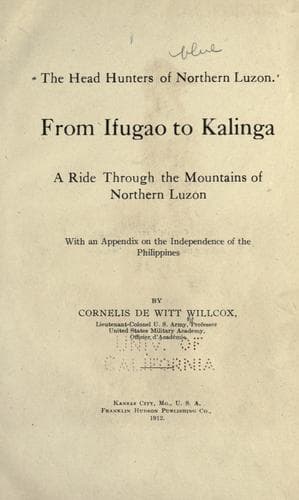
The Head Hunters of Northern LuzonWillcox, Cornélis De Witt
History
The Head Hunters of Northern Luzon
Willcox, Cornélis De Witt
Igorot (Philippine people); Luzon (Philippines) -- Description and travel
We had a long and hard day before us, but we did not know it when we
set out from Tabuk at about seven in the morning. Gallman, Harris,
and I kept together; our first business was to cross a vast, roughly
circular plain fifteen miles in diameter, and densely overgrown with a
rough, reedy grass two feet and more high. A foot-path ran across the
plain, visible for only a very short distance ahead as long as one was
in it, but imperceptible twenty yards to the right or left. To lose
this path would have been a serious matter, as it would have been a
heart-breaking thing to force one's way through the undisturbed grass.
It would be hard to imagine anything else more wearisome than that
fifteen-mile stretch. The sun was riding high in the heavens, "shining
on both sides of the hill"; not a breath of wind was stirring nor
was there, barring a rare bird or two, a sign of life save the
thousands of flies which, as our ponies pushed aside the grass
overhanging the path, rose in clouds only to settle on our faces,
hands, necks, backs, everywhere. We began by brushing them off,
but it was of no use, and so we rode with our faces turned to a dim
haze of low mountains bounding the plain on the east, and themselves
dominated by still another range, the Sierra Madre, so distant as
to look like a bank of immovable blue cloud. For miles our plodding
seemed to bring them no nearer. If we could only get out of that sea
of olive-gray grass, on which the heavy, stifling air seemed to press,
and reach those nearer mountains! Twice the path led us into sinks or
depressions fully ninety or one hundred feet below the level of the
plain; why these could not have been avoided when the path was first
struck out is hard to imagine, unless it was to get to water. For
one of these sinks boasted of a clear, bold stream with all of its
course underground save the part in the depression. In both were
full-grown trees and grateful shade. Had we not been pressed to get
through, it would have been interesting to explore these huge sinks;
but we passed on, the flies, which had abandoned us on our descent,
rejoining us when we climbed out on the other side. In time we reached
our mountains, arid, bare, eroded, wind-bitten, and made our way
slowly and painfully up and through the pass, our trail hereabouts
being nothing but a trench so deep and narrow that part of the way we
could not keep our feet in the stirrups. As we neared the crest of
the range the pass disappeared, and for the last half-mile or so we
attacked the ridge directly. When we got to the top, we found a gallant
breeze blowing, and, spreading out before us, the vast plains of the
Cagayán Valley. Far over in the east, and apparently no nearer than
ever, rose the blue, cloud-like mountains of the Sierra Madre, now
showing like a wall, which indeed they are, and one which no man has
so far succeeded in scaling. But not a sign of life, of man or beast,
caught our eye.
Public-domain text, read in full here on John Shaqi.
Reviews
Reviews
No reviews yet
Be the first to share your thoughts on this work.
Elsewhere in the archive
Join the Discussion
Join the discussion
Sign in to leave a comment or review.
Sign InorCreate an account