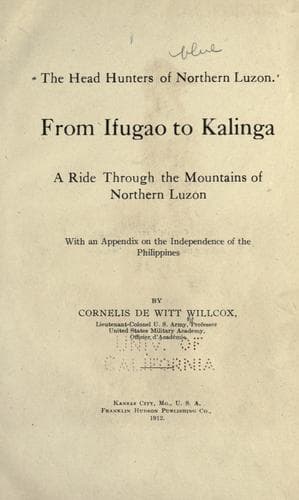
The Head Hunters of Northern LuzonWillcox, Cornélis De Witt
History
The Head Hunters of Northern Luzon
Willcox, Cornélis De Witt
Igorot (Philippine people); Luzon (Philippines) -- Description and travel
And yet this valley is an empire in itself; its axial
stream, the Rio Grande de Cagayán, or Ibanag, the "Philippine Tagus"
of the ancient chronicles, the longest river of the Archipelago, by
overflowing its banks every year, renews the fertility of the soil
wherever its waters can reach. We stood here on the ridge a long time,
resting and looking. Below us green ribbons, following the undulations
of the plain, marked the trail of various water-courses; but, apart
from this evidence of Nature's living forces, somehow or other the
entire landscape was silent and desolate. We now began the descent,
leading our ponies, for it was too steep to ride, and at last came to
a stream where we found shade and grass, and, better yet, the advance
guard of the party with food and drink ready. Our next stage was over
rolling country, covered with fine short grass; once over this, the
ground broke in our front, and we made the descent, finally coming
out on the lowest floor of the valley at Enrile, two or three miles
from the river. Night was falling as we made our way through its
grass-grown streets, finding the air heavy, the people dull-looking,
and everything commonplace: we had already begun to miss our mountains.
CHAPTER XXIV
Tobacco industry.--Tuguegarao.--Caves.--The Cagayán
River.--Barangayans.--Aparri.--Island of Fuga.--Sail for
Manila.--Stop at Vigan.--Arrival at Manila.
The great valley in which we now found ourselves really deserves more
notice than perhaps it is suitable to give it here. As everyone knows,
it furnishes the best tobacco of the Islands, tobacco that under proper
care would prove a dangerous rival to that of Cuba, though it can
never quite equal the product of the Vuelta Abajo. The cattle industry
should prosper here--in fact, did a few years ago; the broad savannas,
some of which we had crossed, furnishing excellent pasturage. It was
proved long ago that this region was naturally adapted to the culture
of silk and to the raising of indigo and sugar-cane. While tobacco
was a Government monopoly, [42] the valley was wealthy, traces of
wealth being still found in the hands of the people under the form
of jewels, some of them costly and beautiful.
Public-domain text, read in full here on John Shaqi.
Reviews
Reviews
No reviews yet
Be the first to share your thoughts on this work.
Elsewhere in the archive
Join the Discussion
Join the discussion
Sign in to leave a comment or review.
Sign InorCreate an account