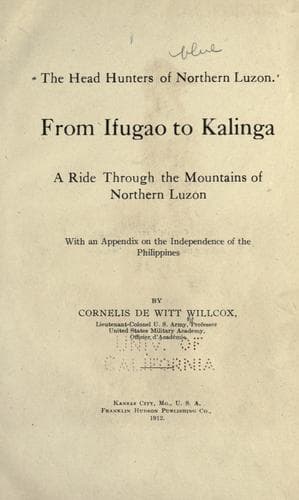
The Head Hunters of Northern LuzonWillcox, Cornélis De Witt
History
The Head Hunters of Northern Luzon
Willcox, Cornélis De Witt
Igorot (Philippine people); Luzon (Philippines) -- Description and travel
The passage of the Payne bill has already brightened the prospects of
the people, and especially of the small growers, for prices paid on
the spot have already gone up very considerably. The valley is sure
to flourish before many years shall have passed, and nothing else
would so much hasten this end as the completion of the railway from
Manila. But when we passed through, a sort of general apathy seemed
to fill the air: the people were listless, and so much of the tobacco
crop as we could see looked neglected. A partial explanation is to be
found in the belief, wide-spread in these parts at this time, that the
comet had come to mark the end of all things, and that any work done
would be wasted. This belief, however, did not check the native and
courteous hospitality of the people; all of us were taken in for the
night, Evans and I going to Señor Cipriano Pagulayan's, where we found
an excellent dinner awaiting us--in particular, coffee of superlative
excellence. Don Cipriano was very modest about it, explaining that the
coffee had been roasted only after our arrival and ground just before
it was set on; but none the less it was admirable. Now, this coffee,
of course, was grown in the valley, and there is no reason why its
cultivation should not be taken up on a large scale for export.
Enrile held us only for the night. The next morning we all mounted,
alas! for the last time, and, escorted by a great number of local
magnates, took the road for the river. Here we left our mounts to
Doyle, who was to return with them to Baguío. It was with great regret
that I parted from Bubud: he had carried me faithfully and well, and
I shall not soon forget his saucy head, looking after us as we got
down the bank to go on board the motor-launch of the Tabacalera. [43]
In a few minutes we had crossed and landed at Tuguegarao, the
capital of the province, and still retaining traces of its wealth
and importance in the great days of the tobacco monopoly. It has an
imposing church built of brick, a hospital, and a Dominican college,
all of substantial construction; its streets are broad and well laid
out, but of the town itself not much can be said, as a fire swept off
most of it a few years ago. Still Filipino towns rise easily from the
ashes, and there is no reason why prosperity should not again smile
upon this ancient borough.
Public-domain text, read in full here on John Shaqi.
Reviews
Reviews
No reviews yet
Be the first to share your thoughts on this work.
Elsewhere in the archive
Join the Discussion
Join the discussion
Sign in to leave a comment or review.
Sign InorCreate an account