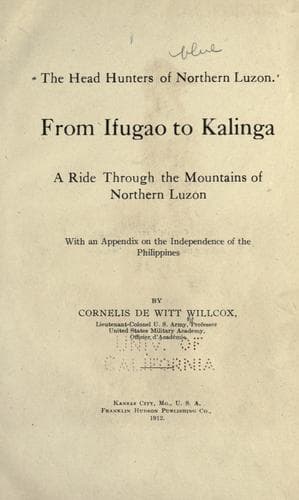
The Head Hunters of Northern LuzonWillcox, Cornélis De Witt
History
The Head Hunters of Northern Luzon
Willcox, Cornélis De Witt
Igorot (Philippine people); Luzon (Philippines) -- Description and travel
told us of coming suddenly one day upon a fight between two bodies
of Kalingas, numbering twenty or twenty-five men each, and this in
Lubuagan itself. According to our ideas, it was no fight at all,
the champions of each side engaging in single combat, while the rest
looked on and shouted, waiting their turn. One man had already been
killed, his headless trunk lying on the ground. On the approach of the
officer they all ran. Here, too, we heard from another Constabulary
officer, that the _insurrectos_ in 1898-1899 forced the Igorots to
carry bells and other loot taken from the _conventos_ and churches,
and would shoot the _cargadores_ if they stumbled or fell, or could
go no farther under the weights they were carrying.
Twenty-four hours later we steamed up Manila Bay. The trip was over.
CHAPTER XXV
Future of the highlanders.--Origin of our effort to improve
their condition.--Impolicy of any change in present
administration.--Transfer of control of wild tribes to
Christianized Filipinos.--Comparison of our course with that
of the Japanese in Formosa.
The question now presents itself: What is to become of these
highlanders of Northern Luzon? And if the answer to be given is
here applied only to them, let it be distinctly understood that
logically the question may be put in respect of all the wild people
of the Philippines. Of these there are over one million in a total
population of perhaps eight millions. At once it appears that
any conclusions we may draw, any speculations we may cherish, in
respect of the Archipelago, as being inhabited by a Christian people
unjustly deprived of liberty by us, must be subject to a very large
and important correction. Limiting our inquiry to Luzon alone, let it
be recollected that of its 4,000,000 population nearly four hundred
thousand, or one-tenth, are highlanders, and that these highlanders,
in all probability, arrived in the Islands at an earlier date than
their Christianized cousins of the lowlands. Let us recollect further
that these people are ethnologically not savages at all; not only
are they workers in steel and wood, weavers of cloth, but hydraulic
agriculturists of the very highest merit. On the side of moral
qualities they invite our approving attention: they speak the truth,
they look one straight in the eye, they are hospitable, courageous,
and uncomplaining; their women are on a footing of equality, more
or less, with the men, and are respected by them. Where they have
had an opportunity, they have shown an aptitude to learn of no mean
quality. Physically they are the best people of the Archipelago, and
under this head would be remarkable anywhere else in the world. Now,
the Spaniards, with a few exceptions, made no systematic, continuous
attempt to civilize these peoples; or, if they did, no measurable
results have come down to our own day, even Villaverde's efforts,
genuine as they were, having left almost no trace. So far from having
Public-domain text, read in full here on John Shaqi.
Reviews
Reviews
No reviews yet
Be the first to share your thoughts on this work.
Elsewhere in the archive
Join the Discussion
Join the discussion
Sign in to leave a comment or review.
Sign InorCreate an account