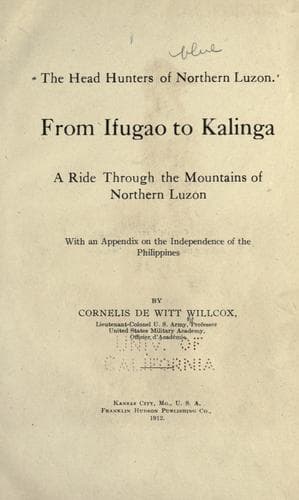
The Head Hunters of Northern LuzonWillcox, Cornélis De Witt
History
The Head Hunters of Northern Luzon
Willcox, Cornélis De Witt
Igorot (Philippine people); Luzon (Philippines) -- Description and travel
done anything for the hillmen, the record of the Spanish at the
very few points garrisoned by them is one of injustice and robbery,
and worse. That of the Filipinos, [45] in imitation of their Spanish
masters, is no better. At any rate, when we took over the Archipelago
in 1898, a vast area of Luzon was held by a people who looked, and
justly, so far as their experience had gone, upon the white man and
his Filipino understudy as an enemy. The difficulty of guiding and
controlling these people undoubtedly had been (and still is) great,
and partly accounts for the state of affairs we encountered when
we first entered the country, but it was necessarily no greater
for our predecessors in the Islands than it has been for us. Now,
where they failed, we, it may be said without fear of contradiction,
are succeeding, and it is but the simplest act of justice to say that
the credit for our success belongs to the Secretary of the Interior of
the Philippine Islands, Mr. Dean C. Worcester. He would be the last
man on earth to say that his success is complete; on the contrary,
he would assert that a very great quantity of work yet remains to be
done, and that what he has done so far is but the beginning. But it is
nevertheless a successful beginning, and successful because it rests
on the solid foundation of honesty and fair dealing, and is inspired
by interest in and sympathy for a vast body of people universally
hated and feared by the Filipino, and until lately neglected and
misunderstood by almost everybody else.
The physical difficulty alone of reaching these various peoples was
not only very great, but mere presence in their country involved
great risk of one's life. Again, the absence of even the rudest
form of tribal organization made the way hard. Take the Ifugaos, for
example, about 120,000 in number, all speaking essentially the same
language, inhabiting the same country, and having the same origins
and traditions. Yet this large body was and is yet broken up into
separate _rancherías_, or settlements, each formerly hostile to all
the others, this hostility being so great that merely to walk into
a neighboring _ranchería_ in plain sight, not more than two miles
off across the valley, was a sure way to commit suicide. And what is
true of the Ifugaos is true of all the others. Could any other field
have been more unpromising, have offered more difficulties? There
were those thousands of savages shut up in their all but inaccessible
mountains. Why not leave them there, to take one another's heads when
occasion offered? They raised nothing but rice and sweet potatoes,
anyway, and not enough of those to keep from going hungry. Why
concern one's self about them, when there was already so much to be
done elsewhere?
Public-domain text, read in full here on John Shaqi.
Reviews
Reviews
No reviews yet
Be the first to share your thoughts on this work.
Elsewhere in the archive
Join the Discussion
Join the discussion
Sign in to leave a comment or review.
Sign InorCreate an account