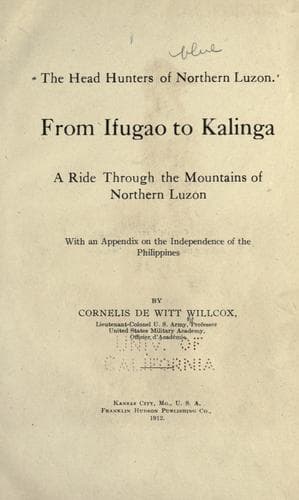
The Head Hunters of Northern LuzonWillcox, Cornélis De Witt
History
The Head Hunters of Northern Luzon
Willcox, Cornélis De Witt
Igorot (Philippine people); Luzon (Philippines) -- Description and travel
To Mr. Worcester's everlasting honor, be it said, he took no
such view. On the contrary, he went to work, and that after a
simple fashion, but then, all great things are simple! The first
thing was to see the people himself; and then came the beginning
of the solution, to push practicable roads and trails through the
country. Once these established, communication and interchange
would follow, and the way would be cleared for the betterment of
relations and the removal of misunderstandings. Today an American may
ride through the country alone, unarmed and unmolested; [46] twenty
years ago a Spaniard trying the same thing would have lost his head
within the first five miles. And this difference is fundamentally
due to the fact, already mentioned, of the honesty of our relations
with these simple mountaineers. We have their confidence and their
esteem and their respect, and this in spite of the necessity under
which our authorities have constantly labored of punishing them when
necessary and of insisting upon law and order wherever our jurisdiction
prevails. The lesson has been hard to learn, but it has been driven
home. The truth of the matter is, that a great missionary work has
been begun; missionary not in the limited sense of forcing upon the
understanding of a yet circumscribed people a religion unintelligible
to them, but in the sense of teaching peace and harmony, respect for
order, obedience to law, regard for the rights of others.
A beginning accordingly has been made, but what is to be the end? We
should not stay for an answer, could we but feel sure that but one
answer were possible. But we can not feel sure on this head; the people
of the Islands, whether civilized or uncivilized, have not yet gone
far enough to proceed alone. To drop the work now, nay, to lessen
it, would merely be inviting a return to former evil conditions. No
greater disaster could befall these highlanders to-day than a change
entailing a diminution of the interest and sympathy felt for them at
the seat of government. It is best to be plain about this matter:
the Filipinos of the lowlands dislike the highlander as much as
they fear and dread him. They apparently can not bear the idea that
but three or four hundred years ago they too were barbarians; [47]
for this reason the consideration of the highlander is distasteful
and offensive to them. The appropriations of the Philippine Assembly
for the necessary administration of the Mountain Province are none
too great; they would cease entirely could the Assembly have its own
way in the matter. The system of communications, so well begun and
already so productive of happy results, would come to an end. To turn
the destiny of the highlander over to the lowlander is, figuratively
speaking, simply to write his sentence of death; to condemn as fair a
land as the sun shines on to renewed barbarism. We are shut up to this
conclusion, not by theoretical considerations, but by experience. The
Public-domain text, read in full here on John Shaqi.
Reviews
Reviews
No reviews yet
Be the first to share your thoughts on this work.
Elsewhere in the archive
Join the Discussion
Join the discussion
Sign in to leave a comment or review.
Sign InorCreate an account