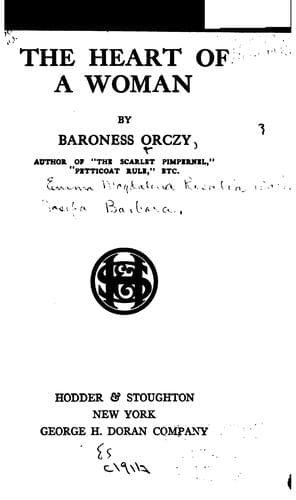
The Heart of a WomanOrczy, Emmuska Orczy, Baroness
General
The Heart of a Woman
Orczy, Emmuska Orczy, Baroness
Murder -- Fiction; Mystery and detective stories
"Well," rejoined the coroner, not unkindly this time--the man who
looked so like a beetle, who was so humble and apologetic, compelled
quite a certain amount of regard--"we'll leave that matter for the
moment, Mr. Baker. Now will you tell the jury what made you come to
this court to-day? What led you to think that the man who had been
murdered in a cab the night before last, and of whom all the
newspapers spoke as Mr. Philip de Mountford--what made you think that
he was your son?"
Jim Baker by way of a reply plunged one of his thin hands in the
pocket of his shabby coat and drew out a portion of very grimy
newspaper carefully folded up quite small. He undid the folds until
his eyes lighted on that which they sought. Then he held the paper
out toward the coroner and pointed to a picture sandwiched in among
the letter-press.
"I saw this," he said, "in the _Daily Graphic_ yesterday. It's the
picture of Paul, I says to myself."
The coroner took the paper from the witness and laid it down on the
table, glancing at it casually. There had been innumerable portraits
of the murdered man published both in the morning and the evening
papers of yesterday.
"It's Paul to the life," insisted Jim Baker. "I was at my work, you
understand, when I seed the paper in one o' the other chaps' 'ands. I
couldn't give up my work then. I 'ad to wait till evenin' to speak to
my missus. Then we talked it all over, and young Smith 'e took a day
off and me too, and Mrs. Baker and Emily and Jane Smith, they all come
along."
"And you looked on the face of the dead man, and you swear that it is
your son?"
"I take my oath, sir. Ask 'is mother there. She knows 'er own son.
She'll tell you just what vaccination marks 'e 'ad on 'is arm, and
about the scar on 'is leg and all. The ladies, sir, they are that
sharp----"
Jim Baker--feeling no doubt that his ordeal was nearly over--was
losing his nervousness, or perhaps it took a new form, that of
jocularity. The coroner thought it best to check his efforts at humour
in the bud.
"That will do!" he said curtly.
And the Clapham bricklayer at once retired within his shell of humble
self-deprecation. He answered a few more questions that the coroner
put to him, but clearly his own circle of vision was so circumscribed
that, willing as he undoubtedly was, he could throw no light whatever
on the unknown events which led up to the extraordinary fraud
practised on the Earl of Radclyffe and which culminated in the
mysterious murder in the taxicab.
The father of the strangely enigmatic personality, who indeed had
taken many a secret with him to the grave, was far too indifferent,
too fatalistic, to put forth any theory as to his son's motives, or
the inducements and temptations which had first given birth to the
astoundingly clever deception.
Wearied and impatient at last the coroner gave up his questionings. He
turned to the jury with the accustomed formula:
"Would any of you gentlemen like to ask this witness any questions?"
Public-domain text, read in full here on John Shaqi.
Reviews
Reviews
No reviews yet
Be the first to share your thoughts on this work.
Elsewhere in the archive
Join the Discussion
Join the discussion
Sign in to leave a comment or review.
Sign InorCreate an account