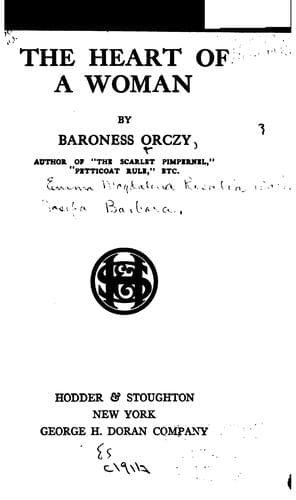
The Heart of a WomanOrczy, Emmuska Orczy, Baroness
General
The Heart of a Woman
Orczy, Emmuska Orczy, Baroness
Murder -- Fiction; Mystery and detective stories
The foreman of the jury wanted to know if the witness's son had any
birthmarks on him, or other palpable means of identification.
"Yes, sir," replied Jim Baker, "but 'is mother'll tell you better'n
me--she knows best--about the vaccination marks and all."
The foreman then asked the coroner whether the jury would be allowed
to identify the marks. On being assured by the coroner that after
adjournment this very day every means would be taken to corroborate
Jim Baker's statement, the jury seemed satisfied.
And the corner called the next witness.
CHAPTER XXX
AND THEN EVERY ONE WENT HOME
Though the hour was getting late, no one among the crowd thought of
leaving the court. Even the desire for tea, so peculiarly insistent at
a certain hour of the day in the whole of the British race, was
smothered beneath the wave of intense excitement which swept right
over every one.
Although the next witnesses--who each in their turn came forward to
the foot of the table--swore to tell the truth and faced the coroner
with more or less assurance, they could but repeat the assertions of
the head of the family; nevertheless the public seemed ready to listen
with untiring patience to the story which went to prove that the man
whom everybody believed to be the heir of one of the oldest titles and
richest rent-rolls in England was the son of a Clapham bricklayer, a
master of audacity and of fraud.
The mother--a worthy and simple soul--was the first to explain that
Paul, her only son, had always been something of a gentleman. He had
done very well at school, and never done a stroke of work like 'is
father. When he was fifteen he was quite stage-struck. "Always
play-acting," as the mother put it, "and could recite poetry
beautiful!"
Mrs. Baker seemed distinctly proud of her son's deeply rooted horror
of work. She thought that all the instincts of a gentleman were really
in him. When he was a grown lad, he went as footman in a gentleman's
family somewhere in the Midlands. The mother loftily supposed that it
was there that Paul learned his good manners.
"He was a perfect gentleman, sir," she reiterated complacently.
It appeared too that the wastrel had had a period in his career when
the call of the stage proved quite irresistible, for he seemed to have
left the gentleman's family in the Midlands somewhat abruptly and
walked on as super for a time in the various melodramas produced at
the Grand Theatre, Nottingham, whenever a crowd was required on the
stage. There seems also to have existed a legend in the heart of the
fond mother and of the doting sister that Paul had once really played
a big part in a serious play. But this statement was distinctly
wanting in corroboration.
Public-domain text, read in full here on John Shaqi.
Reviews
Reviews
No reviews yet
Be the first to share your thoughts on this work.
Elsewhere in the archive
Join the Discussion
Join the discussion
Sign in to leave a comment or review.
Sign InorCreate an account