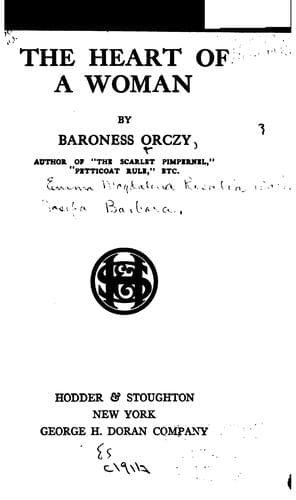
The Heart of a WomanOrczy, Emmuska Orczy, Baroness
General
The Heart of a Woman
Orczy, Emmuska Orczy, Baroness
Murder -- Fiction; Mystery and detective stories
He liked no one and no one liked him: and during sixty years of life
he had succeeded in eliminating from his entire being every feeling of
sentiment save one. He had to all appearances an absolutely callous
heart: he cared neither for dog nor horse--he ordered a splendid mare
to be shot without the slightest compunction after she had carried him
in the hunting field and in the park faithfully and beautifully for
over eight years, just because she had shied at a motor-car and nearly
thrown him. He was not cruel, you know, just callous in all respects
save one: void of all sentiment--he called it sentimentality--save in
his affection for Luke.
Luke had been--ever since he was a growing lad--the buffer in the
establishment between the irascible master and the many subordinates.
From Mr. Warren--the highly paid and greatly snubbed secretary--down
to the maids below stairs, one and all brought troubles, complaints,
worries to Mr. Luke. No one dared approach his lordship. A word out of
season brought instant dismissal, and no one thought of leaving a
place where, besides excellent wages, there was the pleasure of
waiting on Mr. Luke. Never Mr. de Mountford, you notice, always Mr.
Luke. He had grown up amongst the household; Winston, the old
coachman, had taught him to ride; Mary, now housekeeper, then a nurse,
had bathed him in a wash-hand basin when he was less than eighteen
inches long.
Therefore the atmosphere of the gloomy old house pleased Louisa
Harris. With the perfect and unconscious selfishness of a woman in
love, she gauged everything in life just as it affected Luke. She even
contrived to like Lord Radclyffe. He trod on every one of her moral
and spiritual corns, it is true; he had that lofty contempt for the
entire feminine sex which pertains to the Oriental, more than to the
more civilized Western races; he combated her opinions, both religious
and political, without any pretence at deference; he smoked very
strong cigars in every room in the house, without the slightest regard
for the feelings of his lady visitors; he did or left undone a great
many other things which would tend to irritate and even to offend a
woman accustomed to the conventional courtesies of daily social life;
but when Luke entered a room, where, but a moment ago, Lord Radclyffe
had been venting his chronic ill-humour on an offending or innocent
subordinate, the old man's dour face would become transfigured,
irradiated with a look of pride and of joy at sight of the man on whom
he had lavished all the affection of which his strong nature was
capable.
Luke could do no wrong. Luke was always right. He could argue with his
lordship, contradict him, obtain anything he liked from him. Eternal
contradictions of human nature: the childless man in perfect adoration
before a brother's son; the callous, hard-hearted misanthrope soft as
wax in the hands of one man.
CHAPTER VII
THE PART PLAYED BY A FIVE-POUND NOTE
Public-domain text, read in full here on John Shaqi.
Reviews
Reviews
No reviews yet
Be the first to share your thoughts on this work.
Join the Discussion
Join the discussion
Sign in to leave a comment or review.
Sign InorCreate an account