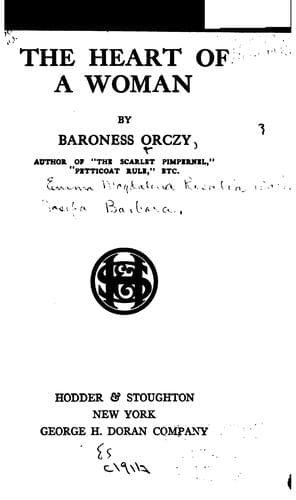
The Heart of a WomanOrczy, Emmuska Orczy, Baroness
General
The Heart of a Woman
Orczy, Emmuska Orczy, Baroness
Murder -- Fiction; Mystery and detective stories
"You," rejoined the other, "were thinking of Luke, and so am I. I have
thought little of any one else since first the crime was reported to
me last night. And long before Travers gleaned the outlines of the
story which Power has just amplified for us, I vaguely guessed at the
broad lines of it. Now that I know it in all its details, I can see
the whole scene in the lobby of the Veterans' Club before me. You may
believe me or not as you like, but as a matter of fact I know quite a
good deal about Luke de Mountford. I have often met him, of course,
and though we have never been very intimate--for I am a busy man and
have but little time for intimacy with my fellow-men--I have had many
opportunities of studying him. He has a very curious power of
self-control--almost an abnormal one I call it, and a morbid hatred of
public scenes or scandal. This of course he shares with a great many
men of his class, and his self-control is all the more remarkable as
he is not by any means the impassive young man about town which he
pretends to be. Well, that same power, I suppose, stood him in good
stead in the lobby of the Veterans' Club. In Power's picturesque
parlance 'there was murder in his eye.' Of course he had been provoked
beyond the bounds of endurance, and if he had rushed at Philip de
Mountford and strangled him then and there, no one would have been
astonished. I should," continued Sir Thomas with emphasis, "because it
would not have been like the Luke whom I had studied. The picture of
two gentlemen at fisticuffs like a pair of navvies would not have been
an edifying one, and Luke--as I know him--would above all wish not to
make a spectacle of himself before the hall porter or before a crowd
in the ante-room of a second-rate club. He naturally--for that sort of
thing becomes second nature--pulled himself together and walked out
into the street."
You must not think for a moment that Sir Thomas Ryder was habitually a
talkative man. Englishmen of his class and type are rarely talkative,
and Sir Thomas's position and occupation had rendered him less
communicative than most. But Colonel Harris and he had been brother
officers, friends long before family ties were closely knit by
marriage, and he considered the present crisis a very serious one.
He had had enough to do with crime in the past few years since he had
obtained the interesting post which he now occupied, but never with a
crime which affected him personally as this one did. Luke de Mountford
was of course nothing to him, except in connection with Louisa Harris.
But this was a strong tie. Louisa was his own wife's niece; she was
the daughter of a friend, of a brother officer. No one who is not in
some manner or other in touch with military men can have the slightest
idea of how much those two magic words mean: "brother officer": what
magnetism lies in them: what appeal they make to all that is most
loyal, most willing, most helpful in a man.
Public-domain text, read in full here on John Shaqi.
Reviews
Reviews
No reviews yet
Be the first to share your thoughts on this work.
Elsewhere in the archive
Join the Discussion
Join the discussion
Sign in to leave a comment or review.
Sign InorCreate an account