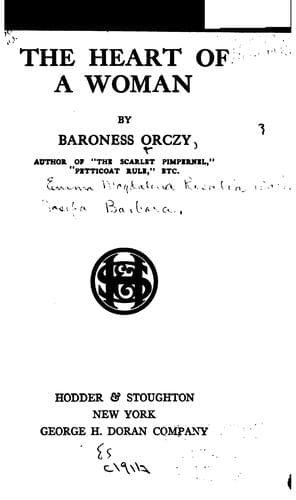
The Heart of a WomanOrczy, Emmuska Orczy, Baroness
General
The Heart of a Woman
Orczy, Emmuska Orczy, Baroness
Murder -- Fiction; Mystery and detective stories
Sir Thomas felt that the mud of irretrievable disgrace which was bound
to smirch Luke de Mountford would in no small measure redound on
Louisa too. Instinctively too all his sensibilities recoiled against
the idea of a gentleman, one of his own caste, being dragged in this
peculiarly loathsome mire. It seemed impossible that that type of man
should commit a murder--a murder--just an ordinary, brutal,
commonplace murder, such as the rough and tumble herd of humanity
commit when under the stress of vulgar passions: greed, avarice,
jealousy. It was this juxtaposition of the mean and sordid against his
own class that revolted Sir Thomas Ryder. He was loyal to his brother
officer in his endeavour to induce him to keep out of all that mud
which would be scattered all round presently, when the papers came out
with their sensational headlines; but he was also--perhaps more
so--loyal to his caste: his was the _esprit de corps_, not only of
militarism but of birth and breeding. He would not, if he could, have
a gentleman held up to opprobrium, and if this could be avoided by the
unfortunate criminal's flight from justice--well, Sir Thomas was ready
and willing to take upon his shoulders the burden of contempt and
ridicule, which the press and the general public would presently be
hurling at him and at his department for their hopeless incompetence
in allowing a murderer to escape.
Therefore he was putting the case against Luke more clearly and with a
greater wealth of detail before his brother-in-law than the
conscientious discharge of duty should have allowed. In fact we see
Sir Thomas Ryder--a hard disciplinarian, a hide and tape bound
official--freely transgressing the most elementary rules which duty
prescribes. He was sitting in his private office with his
brother-in-law, giving away secrets that belonged not to him but to
his department, conniving through the words which he spoke at the
fleeing from justice of a criminal who belonged not to him but to the
State.
He was making the case against Luke de Mountford to appear as black as
it was in effect, so that Colonel Harris and Louisa might take fright
and induce the unfortunate man to realize his danger in time and to
shrink from facing the consequences of his own terrible deed.
But Colonel Harris--with the obstinacy of those who throughout life
have never led but have always been ruled--would not see the case
through his brother-in-law's spectacles. He clung to his own
repudiation of the possibility of Luke de Mountford's guilt. He
behaved quite unconsciously, just as Louisa would have wished him to
behave, had she been present here to prompt him.
To Sir Thomas's most convincing _exposé_ of the situation he lent an
attentive ear, but the shrug of his shoulders when the other man
paused to take breath was in itself a testimony of loyalty to Luke's
cause.
Public-domain text, read in full here on John Shaqi.
Reviews
Reviews
No reviews yet
Be the first to share your thoughts on this work.
Elsewhere in the archive
Join the Discussion
Join the discussion
Sign in to leave a comment or review.
Sign InorCreate an account