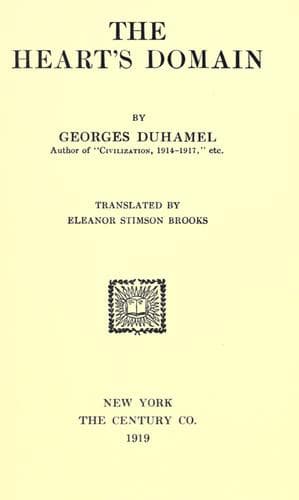
French essays -- Translations into English; World War, 1914-1918 -- Influence
First of all, let us stop over a word. We have said: to possess is to
know. The definition may seem to you arbitrary. On the chance of this I
open my little pocket dictionary, which is the whole library I have as
a soldier, and read: “To possess: to have for oneself, in one’s power,
to know to the bottom.” Let us accept that. We shall see, page by page,
if it is possible for us to satisfy these naïve, direct definitions.
What is most certain to attract our glance, when we look about us, is
the world of men, our fellow-creatures. Their figures are certainly the
most affecting spectacle that can be offered us. Their acts undoubtedly
constitute, owing to a natural inclination and an indestructible
solidarity, the chief object of our curiosity. Good! We shall possess
them first of all. We shall possess this inexhaustible fund of other
people.
We shall feel no shame then in contemplating, with a noble desire,
whatever strikes our senses, the animals, that is to say, the plants,
the material universe of stones and waters, the sky and even the
populous stars. These, too, ought to be well worth possessing!
Already our wealth seems immense. Our ambition is still greater:
we must possess our dreams. But have not illustrious men made more
beautiful dreams than ours? Yes, and these men are called Shakespeare,
Dante, Rembrandt, Goethe, Hugo, Rodin; there are a hundred of them,
even more; their works form the royal crown of humanity. We shall
possess that crown. It is for us it was forged, for us it was
bejewelled with immortal joys.
It would be vain to extend our possession only into space. It overruns
time: we possess the past, that is to say, our memories, and the future
in our hopes.
And then we also possess, and in the strictest sense of all, our
sorrows, our griefs, our despair, if that supreme and terrible treasure
is reserved for us.
Finally, there will be times when we possess nothing but an idea, but
this may perhaps be the idea of the absolute or the infinite. If it is
given us to possess God, then, no doubt, nothing else will be necessary
to us.
Every time that we possess the world purely we shall find that we have
touched an almost unhoped for happiness, for it is always being offered
to us and we do not think of it: we shall possess ourselves.
We shall share all our riches with our companions: that shall be our
apostolate. And we shall manage in some way to resist the seductions
or the commands of a society that is going to ruin, a society that is
even more unhappy and abused than corrupt. If, in consequence, we are
permitted to glimpse, even if only for the space of a minute, a little
more happiness about us, a little more happiness than there is at
present, we shall at last be so happy as to accept death with joy.
IV
Public-domain text, read in full here on John Shaqi.
Reviews
Reviews
No reviews yet
Be the first to share your thoughts on this work.
Join the Discussion
Join the discussion
Sign in to leave a comment or review.
Sign InorCreate an account