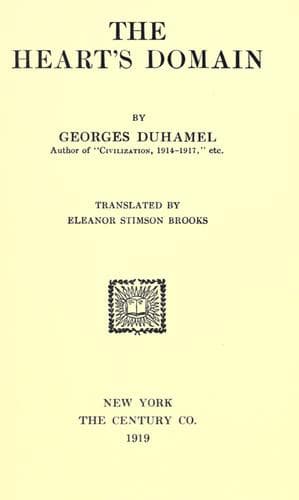
French essays -- Translations into English; World War, 1914-1918 -- Influence
Many men to whom the law allows the gross, official possession of a
statue, a gem, a beautiful horse or a province wear themselves out
fulfilling a rôle to which no human being has received a call. Every
moment they perceive with bitterness that men who have no legal title
whatever to these material goods draw from them a delight that is
superior to the enjoyment they themselves get from them as absolute
owners. They often find, in this way, that a friend appreciates their
beautiful pictures better than they do, that a groom is a better judge
of their own stables, that a passer-by draws out of “their landscape” a
purer joy than theirs and more original ideas. They take their revenge
by obstinately confusing the usage of a thing with its possession.
Jesus said that the rich man renounced the kingdom of God. He renounces
many other things as well. For if he shuts himself up within his proud
walls, he abandons the marvelous universe for a small fragment of it;
and if he is actually curious about the universe, if he appreciates
its significance, how can he consent without guilt to hide a portion of
it away from the contemplation of others?
In order to express the gross and exclusive possession of things
society has invented various words and phrases that betray the weak
efforts of men to appropriate for themselves, in spite of everything,
in spite of the laws of love, the riches that remain the prerogative of
all. They speak, for example, of “disposing of a piece of property,”
which means having it subject to our pleasure, being able to do as
we choose with it. The sacrilegious vanity of this view of the world
gives the possessor, as his supreme right, the power to destroy his
own treasure. He could not, indeed, have a greater right than that.
But what sort of desperate possession is it, I ask, that considers the
destruction of the object possessed as the supreme manifestation of
power?
The world has long known and still knows slavery. Lords and masters
claimed the extravagant right of disposing of other human beings.
They all insisted, as a mark of authority, on their right of dealing
death to their slaves. But truly, what was the power of these despots
compared with the deep, sensitive, voluntary bond that united Plato to
Socrates, or John to Christ?
Epictetus suffered at the hands of Epaphroditus. For all that,
Epaphroditus was not able to prevent his slave from reigning, through
his thought, over the centuries. Epaphroditus’ right of possession
seems to us ridiculous and shameful. Who can fairly envy him when so
many centuries have passed judgement on him?
VI
Every philosophy has given magnificent expression to these immortal
truths. What can we add to the words of Epictetus, of Marcus Aurelius,
of Christ in regard to the vanity of those riches which alone society
admits to be of value?
Public-domain text, read in full here on John Shaqi.
Reviews
Reviews
No reviews yet
Be the first to share your thoughts on this work.
Join the Discussion
Join the discussion
Sign in to leave a comment or review.
Sign InorCreate an account