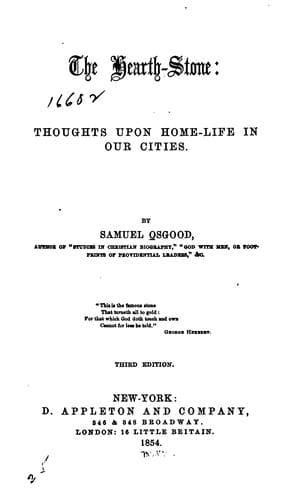
The Hearth-Stone: Thoughts Upon Home-Life in Our CitiesOsgood, Samuel
Religion
The Hearth-Stone: Thoughts Upon Home-Life in Our Cities
Osgood, Samuel
Christian life; Conduct of life
This was the meeting--such was the reconciliation! Full as it is of
absorbing feeling, its moral element is not to be forgotten. Read its
lessons, and we note first of all forgiveness of the offence in view of
the penitence of the offender; secondly, restoration to favor on the
ground of amendment; thirdly, justice to all parties and no injustice to
the rights of the elder son, who had not wasted his patrimony, yet, who
was moved to look with a jealous eye at the feasting in honor of his
prodigal brother's return. Mercy is triumphant, yet justice is not
slighted, and whilst the prodigal is restored to his place in his father's
heart and household, all the consequences of his transgression do not
cease; his portion of the substance is not as if he had wasted nothing,
and he is not exempt from a long course of self-discipline and correction.
Forgiveness does not end discipline, but rather begins its just action, by
bringing the offender into the sphere of moral and spiritual allegiance.
Such is the story of the Prodigal Son in his fall and his recovery--a rich
lesson of earthly experience and of heavenly faith. What family is there
that is not called at some time, and in some measure, to apply its point
to themselves?
Parents and guardians have some trials that the world knows of, and some
that escape the public ear. Rare, indeed, the home that has no trace of
the prodigal, and makes no demand on the heart of forgiveness. Our
prevalent manners seem to set a bounty upon prodigality, and make youth,
the true season of control and preparation, the ill-timed season for
indulgence and extravagance. Many sons have the spending of a prince's
income without the spur of a prince's ambition; and probably not a few
families in our own community encourage a reckless waste that would be
thought wicked in many a palace; whilst the self-will, thus pampered, is
not trained to labor for any definite aim or worthy object. In homes less
affluent, the case may be still worse, and the sons and daughters of
persons in a medium position catch the bad ambition, and launch out into
an extravagance as ruinous as it is infatuated. It is wrong--all wrong.
The prodigal, in his craving for pardon, well marked the error of his
course, and proved how much he had sinned against a father's purpose in
intrusting him, prematurely, with such means of usefulness and honor, to
be squandered in idleness and shame. Happy they who learn the lesson
without such bitter experience, and who start from the first with a worthy
object in view. Here is the great question that over presses upon us: How
check the waste of talent and substance among our youth? how redeem the
most susceptible years from frivolity and extravagance? There can be
essentially but one answer, however various the forms of its expression.
From the very first, let the young be trained to pursue some worthy
object, and let the ideal of dignity be placed not in dainty indolence,
but in active usefulness.
Public-domain text, read in full here on John Shaqi.
Reviews
Reviews
No reviews yet
Be the first to share your thoughts on this work.
Elsewhere in the archive
Join the Discussion
Join the discussion
Sign in to leave a comment or review.
Sign InorCreate an account