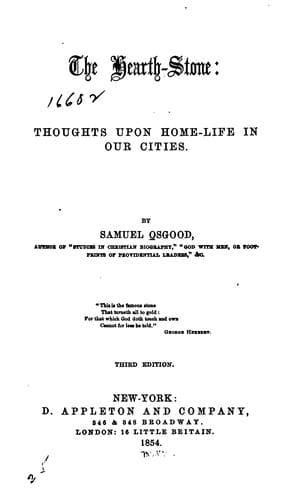
The Hearth-Stone: Thoughts Upon Home-Life in Our CitiesOsgood, Samuel
Religion
The Hearth-Stone: Thoughts Upon Home-Life in Our Cities
Osgood, Samuel
Christian life; Conduct of life
Look to the other side of the picture, and think of what has been going on
in the father's heart. No particulars are given of his feeling during the
season of separation, but his heart is a chapter in the book, that life
is ever laying open, and what is told of him at the crisis, indicates
well his temper during the interval. He had but two boys, and his whole
hope and love must have centred in them and their destiny. They may have
been dearer to him from being all the memorial left to him of the mother
long since taken from the world. The younger may have been the pet of his
leisure hours, whilst the elder was busy with the cares of the farm; for
there is likely to be a pet child in every family. But the plain facts are
enough without laying any tax upon the imagination. He had the common
heart of good men, and had shown his willingness to make sacrifices for
his children. Many a time in lonely hours he must have thought of the
wanderer, and wondered if the boy whom he never forgot, could forget him.
The prosperity of his business, the plenty of his crops, the number of his
flocks and herds, could not satisfy him; even the sight of the son now
with him, but reminded him how broken was his family and how divided his
heart. Touches of compassion would mingle with his lonely regrets, and
remembering the common weakness of our humanity, he would consider the
amount of temptation in wait for every novice, and have misgivings at
allowing him to go out alone into the world. Many a time his wistful gaze
would rest upon the road taken by the departing wanderer, and he would ask
himself if the youth would ever return, and in what condition. One day as
he looked, that lonely road had for him a startling apparition. Far in the
distance appears a tired, tattered wayfarer, a mere vagrant to the common
gaze; but one of the many who seem heir of misery, and for whom
compassion itself has little reasonable hope. But no; the eye of affection
is ever sharpsighted, and the father sees under that beggar's garb the
step and air of his long-lost son; and one look tells to him the whole
story of his fortunes. He is a poor and broken-down creature, and comes
home penitent, to ask mercy of the love that he had so offended. All is
told in those simple words of welcome "But when he was yet a great way
off, his father saw him, and had compassion, and ran, and fell on his
neck, and kissed him."
Public-domain text, read in full here on John Shaqi.
Reviews
Reviews
No reviews yet
Be the first to share your thoughts on this work.
Elsewhere in the archive
Join the Discussion
Join the discussion
Sign in to leave a comment or review.
Sign InorCreate an account