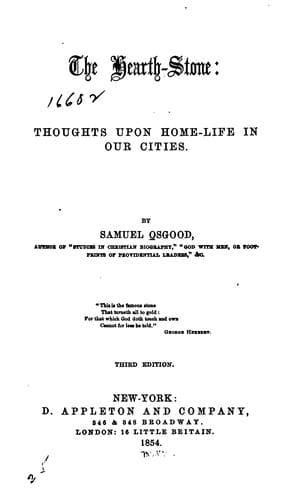
The Hearth-Stone: Thoughts Upon Home-Life in Our CitiesOsgood, Samuel
Religion
The Hearth-Stone: Thoughts Upon Home-Life in Our Cities
Osgood, Samuel
Christian life; Conduct of life
But this is not the chief danger now, but an opposite extreme equally
degrading. The danger is not that the daughter shall lack polish, but that
she will have but little else; and, instead of being a polished stone,
shall be a polished vanity with no substance at all. Nothing can be more
false and fatal than the notion that a daughter is to be educated for
show, whilst the son is to be trained for usefulness. In her own way, the
sister has quite as much strength of character as the brother has in his
way, and she is cruelly treated when regarded only as a graceful toy.
Sometimes this extreme meets the other, and she who in her girlhood was a
dainty plaything, becomes in womanhood a plodding drudge, without a
particle of worthy spirit or elevated thought to retain the love won by
her beauty, or to replace the fervor lost with her youth. It is very wrong
to make accomplishments the main thing in female education.
Accomplishments are poor tricks, unless their polish is but the smoothness
of substantial knowledge and judgment. A showy girl who can dance, sing,
and prattle two or three foreign languages, without being able to speak
and write sensibly in her own tongue, is one of the most lamentable of
counterfeits, and may chance to blight the peace and dignity of more
hearts than one by her shams. She is the product of that flashy system of
training, which is doing more mischief in America than any where else, and
making society a tawdry Vanity Fair instead of a companionship of hearts
and homes. Not a few of our daughters seem taught to think that
distinction in society is graduated by clothes and confectionery, and to
measure their social honor or obscurity by their ability to follow the
silly code of extravagance. If the folly were confined to those who have
such affluence as craves prodigality in expense to reduce the overplus, it
might be comparatively harmless, but it bears most severely upon families
of limited means, where mothers and daughters are in a fever to ape the
extravagance that they ought to pity. Why all this infatuated excess in
dress? What do our daughters, in their tender years, need for their grace
and dignity beyond the simplest costume that good taste dictates as the
fit robing of girlish innocence? Even a pure French taste, which, in other
respects favors such excess, teaches an almost Christian simplicity in
this respect; and the spectacle, so common with us, of school girls
bedizened with costly dresses of all colors, and loaded with jewels, would
be ludicrous in a Parisian drawing-room, as a walking, jingling toy-shop
attached to a human creature. It is a fine remark of Fenelon in rebuking
the foolish passion for dress, that if daughters were educated in a purer
classic taste, and would study the beautiful in the schools of painting
and sculpture, they would shun many excesses in costume on account of
their deformity, as well as their extravagance. What judgment the good
Public-domain text, read in full here on John Shaqi.
Reviews
Reviews
No reviews yet
Be the first to share your thoughts on this work.
Elsewhere in the archive
Join the Discussion
Join the discussion
Sign in to leave a comment or review.
Sign InorCreate an account