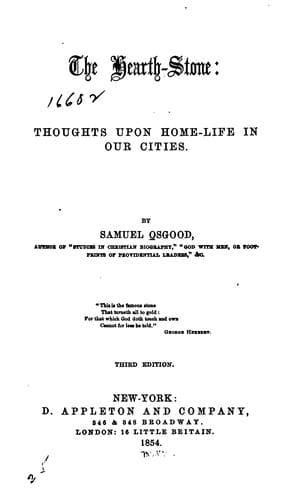
The Hearth-Stone: Thoughts Upon Home-Life in Our CitiesOsgood, Samuel
Religion
The Hearth-Stone: Thoughts Upon Home-Life in Our Cities
Osgood, Samuel
Christian life; Conduct of life
archbishop would have passed upon our present mode of sweeping the dusty
sidewalks with costly robes of silk and velvet, we have no means of
judging, for this folly seems a recent invention. What a recent French
moralist, who claims to walk in the path of Fenelon, says of France, is
doubly true of America: "The great care," says L'Aime Martin, "is to
please the world, rather than to resist it: the wish is to shine, to
reign:--vanity, that is the end to which tender mothers do not cease to
point their daughters, and upon which the world that pushes them on sees
them wrecked with indifference! Vanity in accomplishments! vanity in
dress! vanity in learning! This show covers all: to seem, not to be, makes
the sum and substance of education." These strong words must have cost the
bland French moralist some pain; but does not their strength come from
their truth? Do they not apply, with fearful truth, to American society?
Does not the prevalent code of feminine ostentation bear with cruel
weight upon our domestic life, making almost a social necessity of the
merest conventional artificiality, and raising up a generation of listless
imbeciles, who measure their social salvation by the magnitude of their
exactions and the littleness of their achievements? in short, setting up a
code of dignity, in which utter uselessness not seldom bears the highest
honor. It would be, probably, a somewhat peculiar revelation, if the young
women who go from boarding-schools into our gay society were to submit to
a thorough catechizing as to what they expect to receive in the world, and
what they expect to do in return. The statistics thus gathered might shed
some light upon our social and political economy, and disclose a standard
of empty extravagance, not very common among the titled nobility of the
Old World. Away with the error upon which the whole mischief rests,--the
error that our daughters are not rational creatures, and that the very
strength of their character is not the best reason and rule of their
accomplishment. Let them be polished stones, not tinsel, with a refinement
and solidity worthy their endowments.
Public-domain text, read in full here on John Shaqi.
Reviews
Reviews
No reviews yet
Be the first to share your thoughts on this work.
Elsewhere in the archive
Join the Discussion
Join the discussion
Sign in to leave a comment or review.
Sign InorCreate an account