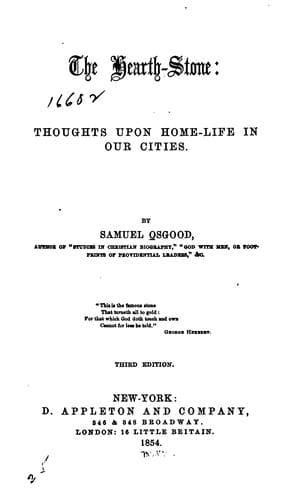
The Hearth-Stone: Thoughts Upon Home-Life in Our CitiesOsgood, Samuel
Religion
The Hearth-Stone: Thoughts Upon Home-Life in Our Cities
Osgood, Samuel
Christian life; Conduct of life
How great a thing it is to understand a soul, said Theresa of Spain, in
view of the young hearts committed to her care after all her own trials of
faith. How great a thing it is to understand a daughter's mind in which
sensibility, that demands sympathy, has so much larger a place than logic,
that needs only to be reasoned out. We believe that there is sex in mind,
and that the essential type of womanhood appears equally in the example of
the highest culture and genius, as in the average standard. Every page
shows the woman's guiding pen, no matter whether a De Stael or a Godwin
ranges into the bolder realms of thought, or an Edgeworth or Hemans walks
among the daily affections and cares of life. A true culture must be based
upon this fact, and the mind must be trained in accordance. Little may be
gained by persisting in making a dry logician of a school girl, for
abstract reasoning is rarely a woman's forte, but precisely on that
account, the reason must be appealed to by the living truth, which will
find a ready response from perceptions so quick and intuitive as often to
see at a glance what the logical understanding will with difficulty argue
out.
It is a great mistake to try to train a girl to be a man in cast of mind
or way of life. We can never slight the hint of nature without bringing
down her retribution, and temporary success but delays the evil day. What
better instance of this error have we than in the memoirs of that gifted
woman so well known to most of our readers, and probably a personal friend
to not a few of them, Margaret Fuller Ossoli? Her mental career is now
made public property by able and congenial biographers; and who of us does
not see the unconscious cruelty of the stern discipline which sought to
mould her mind after the masculine standard, and which so repressed the
springs of feminine power, until Providence took the noble woman into its
own school, and the wife and mother learned a wisdom and a peace that
classic letters and metaphysical theories never taught her; nay, far
beyond the stature of the "Muse," and the "Minerva," that were once her
chosen types of female dignity? Honor to her name, alike for the mistakes
and the excellencies illustrated by her eventful life?
Public-domain text, read in full here on John Shaqi.
Reviews
Reviews
No reviews yet
Be the first to share your thoughts on this work.
Elsewhere in the archive
Join the Discussion
Join the discussion
Sign in to leave a comment or review.
Sign InorCreate an account