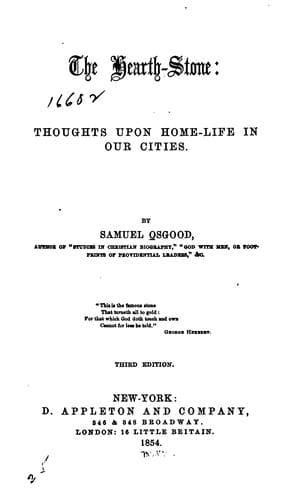
The Hearth-Stone: Thoughts Upon Home-Life in Our CitiesOsgood, Samuel
Religion
The Hearth-Stone: Thoughts Upon Home-Life in Our Cities
Osgood, Samuel
Christian life; Conduct of life
Truly trained, the girl will have as much _reason_ as the boy; and hers
will be more intuitive, whilst his may be more formal and severe in its
_reasoning_. Strength of character will be hers, not, perhaps, so much the
stern sense of justice that most marks the masculine conscience, as the
full and earnest affection that adds mercy to justice and love to duty.
Force of will shall be hers, not perhaps the iron will of man, but what is
quite as well, and in its place better, the heroic patience that conquers
evil by enduring it. The result shall be a disciplined, sagacious
intellect without masculine hardness, delicate sensibility without
imbecile listlessness, active energy without moping drudgery, a
combination of powers and graces that wins homage from every heart.
I would not adopt any definition of woman's powers less generous than the
hint of nature and the will of God. Rather allow the largest scope to the
development of every gift, and trust the feminine instinct to vindicate
its own prerogative, whatever be the talent called into requisition.
Marked cases show that the feminine mind may sometimes have the faculty
for the severest mathematical reasoning, and England and America have been
taught this fact by the philosophical achievements of women who are an
honor alike to the delicacy and the intellect of their sex. Full well do I
remember a visit to William Mitchell the Nantucket astronomer, years ago,
when I saw that the father and the daughter had each a station and a set
of instruments for taking simultaneous observations of the heavens. Since
that day a gold medal from the king of Denmark has marked the daughter's
triumph as the discoverer of a new comet. I am not ashamed to say, that at
the time of the visit I had been several days puzzling over a difficult
sum in algebra, and that, with a few touches of her pencil, the young lady
made clear as day what I had but suspected, that the difficulty was in an
error of the text-book. She evidently understood Arbogast's polynomial
theorem better than I did.
Public-domain text, read in full here on John Shaqi.
Reviews
Reviews
No reviews yet
Be the first to share your thoughts on this work.
Elsewhere in the archive
Join the Discussion
Join the discussion
Sign in to leave a comment or review.
Sign InorCreate an account