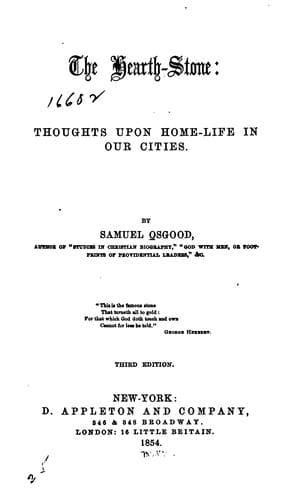
The Hearth-Stone: Thoughts Upon Home-Life in Our CitiesOsgood, Samuel
Religion
The Hearth-Stone: Thoughts Upon Home-Life in Our Cities
Osgood, Samuel
Christian life; Conduct of life
But the great difficulty in this whole matter is not so much in a proper
definition of characteristics to be cherished, as in the application of
proper motives to bring out those characteristics. With boys the motive is
near at hand, for the world speaks to them with its imperious voice and
bids them prepare for some specific post of profit or ambition. Without
such practical spur, our sons would be a languid generation, since
self-culture merely for its own sake, as an amateur pursuit without any
specific object, is a dull affair, that very feebly goes. Even those young
men who have had a thorough collegiate education are very apt to forget
their learning, and to lose their literary gift unless they carry out the
work of education in actual affairs and keep their attainments by using
them. What shall take the place of such motive in the education of our
daughters? What aim shall we place before them in their early studies and
keep before them in after years? Serious indeed is the question, and too
frivolously answered by the hosts of bright girls who go from school into
a career of folly and dissipation.
There can be but one answer, and that the most Christian word. It is
simply this:--"Daughter, you are under God's rule, and all your gifts and
acquisitions are sacred trusts. Consecrate them by a true service. Look
upon your life as folly and nothingness, until you regard it as a solemn
charge and resolve to use its opportunities faithfully. Choose in the
first bloom of your hope the true, the Christian standard of character,
and give religion the grace and power of your youthful enthusiasm. You
have from Heaven itself a sacred commission, large as the sphere of your
sex, specific as the compass and aim of your own individual talents and
position." Take this ground, and it will appear that the daughter will
find in her own religious susceptibility, and in the Divine grace, a
motive to self-culture as efficient as the son finds in the spur of
business and competition. Both indeed need the same religious discipline,
but the one needs it more as an impelling, the other more as a restraining
motive.
Public-domain text, read in full here on John Shaqi.
Reviews
Reviews
No reviews yet
Be the first to share your thoughts on this work.
Elsewhere in the archive
Join the Discussion
Join the discussion
Sign in to leave a comment or review.
Sign InorCreate an account