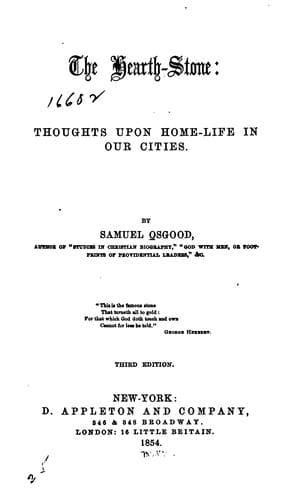
The Hearth-Stone: Thoughts Upon Home-Life in Our CitiesOsgood, Samuel
Religion
The Hearth-Stone: Thoughts Upon Home-Life in Our Cities
Osgood, Samuel
Christian life; Conduct of life
That was a beautiful and expressive ordinance of the Old Dispensation
which enjoined a rural festival upon the conscience of the faithful. Every
year the whole nation were ordered to pass a week in rural bowers woven of
the boughs of goodly trees, in remembrance of the time when their fathers
dwelt in the wilderness, and God led them to the Land of Promise. By the
Israelites, the ancient festival is still remembered, and one of the most
gifted of their modern writers thus describes its observance in Southern
Europe.
"Large branches of the palm and cedar, the willow, acacia and the oak, cut
so as to prevent their withering for the seven days, formed the walls of
the tent; their leaves intermingling overhead so as to form a shelter, and
yet permit the beautiful blue of the heavens to peep within. Flowers of
every shade and scent formed a bordering within, and bouquets, richly and
tastefully arranged, placed in vases, filled with scented earth, hung from
the branches forming the roof. Fruit, too, was there,--the purple grape,
the ripe, red orange, the paler lemon, the lime, the pomegranate, the
citron."
This festival in its ancient form, Christians do not observe, although we
may see some of its traces in the camp-meetings of Methodism and in the
evergreen boughs of Catholicism. Yet its essential idea should, and does
remain. Each year we are sadly dull and worldly, if the luxuriance of
summer does not lift our thoughts to Him who sustained our fathers in
their hard conflict with rude nature, and enabled them to change the
savage wilderness into fertile fields, and peaceful groves. Grovelling
indeed we are, if, upon our return from the pleasant retreats where we
have sought rest and recreation, we cannot bring back some grateful
remembrances of what we have seen and enjoyed in rural places.
The old festival, kept as it was by the whole nation at Jerusalem, in
green tents, was a kind of annual consecration of the relation between the
city and the country. Thus the feast had at once a special and an
universal meaning. The bigot may have thought only of the years of
wandering, when, in nomad tents, the chosen race escaped from their
oppressors. But more enlarged and sensitive minds, of the race of David
and Isaiah, interpreted the season far more generously; and we are assured
by the presence of Him who went from Nazareth to take part in the scene,
that some eyes looked upon those rural tabernacles which stood among the
streets of Jerusalem, as emblems of the permanent relations which man
should sustain to nature,--of the constant ministry of the works of God to
man.
Our topic now is the relation between the town and the country, especially
the power of rural life upon them who dwell in cities.
* * * * *
Public-domain text, read in full here on John Shaqi.
Reviews
Reviews
No reviews yet
Be the first to share your thoughts on this work.
Elsewhere in the archive
Join the Discussion
Join the discussion
Sign in to leave a comment or review.
Sign InorCreate an account