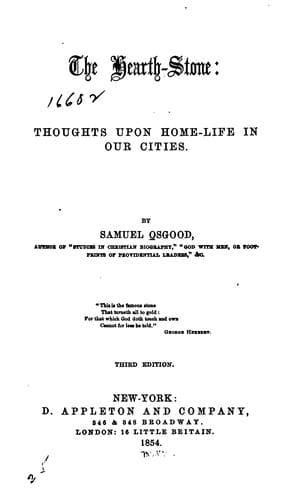
The Hearth-Stone: Thoughts Upon Home-Life in Our CitiesOsgood, Samuel
Religion
The Hearth-Stone: Thoughts Upon Home-Life in Our Cities
Osgood, Samuel
Christian life; Conduct of life
We consider first the various objects which present themselves for
contemplation. Cowper's contrast may have been too strong, when he said
that "God made the country, and man made the town," for, in both places,
we are surrounded by the works of God and man. The farm, as well as the
busy street, shows what human toil can do, and they that live in cities
are in themselves, and in the plenty that sustains them, constant proofs
of the bounty of God; whilst upon all places the sunshine and the rain do
fall with equal mercy. Yet, in the country, we see more of nature in its
divine adaptations, less perverted by the artifices of man. The eye is not
limited by streets and walls to some narrow spot, nor is the landscape
curtailed of its breadth and beauty to suit the grasping policy of
traffic. Generally the hand of rural art and labor rather interprets than
obscures the plan of nature. The regions well cultivated are often the
most picturesque, and at once charm by their scenery, and instruct by
their varied uses and adaptations. We see man in just relations towards
the soil as its cultivator, and towards the animal world as their master
and friend. He lives in close sympathy with the heavens, the earth, the
animated tribes. The sun in its rise, and course, and setting, counts to
him the hours, and divides his times of labor and repose. He breathes the
air as the Creator mingled it, and draws from the soil something of that
quickening, vital force, which the great Mother never refuses to her
children, who seek her. He enlarges the circle of his friendships more
widely even than in metropolitan coteries, and has friends among birds and
fowls; while, with the sheep, and horse, and ox, as well as with kindly
neighbors, he can keep company. He is daily called to see the harmonious
plan of the universe, the co-operation between light, and air, and rain,
and dew, between all elements and all creatures in the universe of God. In
fact, apart from any philosophical curiosity, the very necessity of his
calling must make him not a little a sage in the observation of nature.
When science is added to observation, the greater, of course, the
privilege of his position, the more readily does he unlock the treasures
around him, and his rural hours may be hours of favored vision, nay, of
sacred communion.
Public-domain text, read in full here on John Shaqi.
Reviews
Reviews
No reviews yet
Be the first to share your thoughts on this work.
Elsewhere in the archive
Join the Discussion
Join the discussion
Sign in to leave a comment or review.
Sign InorCreate an account