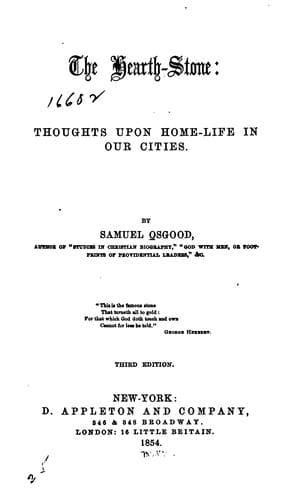
The Hearth-Stone: Thoughts Upon Home-Life in Our CitiesOsgood, Samuel
Religion
The Hearth-Stone: Thoughts Upon Home-Life in Our Cities
Osgood, Samuel
Christian life; Conduct of life
It is the Eve of Christmas, and above the cheerful family circle that
gathers about the hearth, the faces of the holy family look benignly down,
and Mary's own smile seems to brighten the genial light. All surely must
call that mother blessed, who celebrate the birth of the Holy Child. The
Angel of the annunciation seems always to be speaking anew in the anthem
of the Nativity as if the voice which told Mary of her high destiny
celebrated also its fulfilment, and the "Hail Mary" were but the prelude
of the "Glory to God in the Highest."
Our thought this evening turns upon the Mother of Christ, as illustrating
the ideal of woman and the sources of her power. In the manger at
Bethlehem, the mother and child were together--together during the years
of preparation for the public ministry--together at the cross. We honor
both in honoring either. Especially in calling Mary blessed, do we honor
Christ, for we remember not merely what she was to him, but what he has
been to her and her sex and her race.
* * * * *
Let us look at the subject from our own point of view, nor try to put on
the mask of affected sentiment or to stand on the stilts of borrowed
dogmas. There is much beauty and power in the Catholic notions of the
Blessed Virgin, but they are not our convictions. The sweetest hymns in
the Breviary are in her praise, and her heavenly face has been the chief
charm of Catholic art, else altogether too grim with spectral monks and
ghostly confessors. This one fact it is most interesting to remark, that
as Christianity was divested of its genial and humane graces, and our
Saviour himself was removed from the personal sympathies of men by a faith
too forgetful of his humanity in vindicating his divinity, the affections
of Christians sought in the Blessed Mother the solace denied them by
prevalent views of the Divine Son. As the monkish spirit grew darker, the
face of Mary beamed more brightly. The age that embodied its terrors in
the "Dies Irae," breathed its tenderness in the "Stabat Mater," the
exquisite hymn whose authorship, strange to say, has been with show of
reason ascribed to the most thorough-going of the Popes, Innocent the
Third, the man who dared to put England under an interdict. It is not for
such reasons that we are moved to speak of Mary now. We are not oppressed
by a religion that so crushes the natural affections and rebukes the
domestic feelings, that we need to look for solace to one taken
arbitrarily from her place among women and invoked as Queen of Heaven,
above all saints and angels, next to God. Looking upon our homes, so
pleasant and so genial with woman's graces and children's gladness, we
prefer to say the "Hail Mary" as the gospel gives it, and not as the
priest has understood it. We can say, "Blessed art thou _among_
women"--_among_ them, not _above_ them--among them to illustrate their
mission from God, their work on earth--their part in heaven.
Public-domain text, read in full here on John Shaqi.
Reviews
Reviews
No reviews yet
Be the first to share your thoughts on this work.
Join the Discussion
Join the discussion
Sign in to leave a comment or review.
Sign InorCreate an account