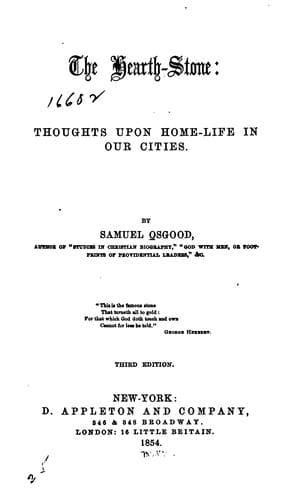
The Hearth-Stone: Thoughts Upon Home-Life in Our CitiesOsgood, Samuel
Religion
The Hearth-Stone: Thoughts Upon Home-Life in Our Cities
Osgood, Samuel
Christian life; Conduct of life
Happy the man who understands self-discipline, so as to secure this charm,
and mingle constancy and variety in his pursuits. He will divide days and
years in such a way that life shall be ever more constant and more fresh.
No servile drudge to worldly care, no capricious pleasure-seeker who is
always uneasy, because always sated, he will be a faithful worker and a
cheerful friend, stronger for work by recreation, the wiser for enjoyment
by his work,--filling his time with such varied uses, that recurrent
duties shall be welcome to him each in its time, and every day's life
illustrate in some way the varied uniformity of God's plan for nature and
humanity. Great obstacles, we know, lie in the way of such order; for care
is often too imperious and protracted, and pleasure too engrossing, to
make true method easy; but the obstacles yield before a just purpose, and,
in the end, every man is the artificer of his habits. He can make his life
constant to its appointed round, and varied in its constancy.
* * * * *
So God teaches us the moral significance of the law of return, by showing
its bearing on the stability and freshness that give charm to our days.
Yet more, he teaches us to find in it the true law of progress. He bids us
return, but not the same, nor to the same,--he bids us return better or
worse, and to a state of things better or worse. This is a necessity, and
we are called to make it a happy necessity. Not in a circle of absolute
uniformity, but in a rounding path, in a spiral course, we wind our way
upward or downward,--our way turning indeed ever upon itself, yet at a
higher or lower mark. The very structure of language indicates that true
progress is the returning of the mind towards its previous experience.
What is the accumulation of knowledge but remembering the facts of
previous observation? What is wisdom but the fruit of reflection, or
turning thought backward upon its course? What is repentance but
conscience revising past errors? What is reformation but the whole man
returning to himself and to God? It is progress that gives its most
cheering aspect to the recurrent order of life.
Public-domain text, read in full here on John Shaqi.
Reviews
Reviews
No reviews yet
Be the first to share your thoughts on this work.
Elsewhere in the archive
Join the Discussion
Join the discussion
Sign in to leave a comment or review.
Sign InorCreate an account