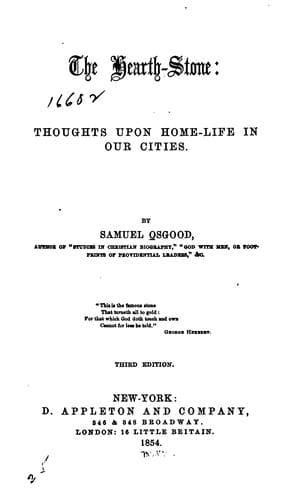
The Hearth-Stone: Thoughts Upon Home-Life in Our CitiesOsgood, Samuel
Religion
The Hearth-Stone: Thoughts Upon Home-Life in Our Cities
Osgood, Samuel
Christian life; Conduct of life
Return then to thine own home as each day, or week, or season repeats the
decree. Return to do better than you have ever done,--to see more clearly
than before the demands of your position, the errors of your way of
living, your indifference, perhaps unkindness, towards those who daily
look to you for a nurture, better than that of perishing bread. Return to
thine own house, and consider whether among the guests there welcomed, the
only abiding Comforter is entertained, and the good angels that go with
him are not shut out. Return with thought more free to see things as they
are from your temporary absence from the trammels of routine, with
affections fresh from nearer companionship with nature, with powers
renewed for the sober work of life. Let fortune smile or frown more than
of old, make sure of your own soul, and do better than you have done.
Constant and varied in many respects our life must be. God bids us add
progress to the constancy and variety that he has decreed. True to him,
our days in their returning order, their various events, their steady
progress, shall go forward, like the march of the faithful host to the
promised land, their step responsive, their way opening new attractions,
their course ever onward, and above them, swelling sweet and clear, that
glorious psalm of jubilee, which in its rhythmic verse and progressive
flow ever returns upon the same rapturous burden, and repeats the
hallowed anthem, "His mercy endureth for ever."
Let this be our spirit, and we shall know how wonderfully God reconciles
two things apparently contradictory; we shall know, that the greater our
progress, the surer our return,--that more and more the blessed scenes and
friends of early days shall come back to us. Memory shall mate with hope
to cheer us, and the evening of life shall add to its own tranquil beauty
the fairest charms from the morning of our days. The aged man turns ever
fondly to his childhood, and may enter the kingdom of heaven like a little
child, even before death unlocks its gates of eternity.
What a thought here opens--opens to us as we return to our homes, and
think of some who return no more! Beyond these homes, the orbit of our
being reaches, and one, nay, many call to us, "Come." Over the grave the
decree is still more solemnly heard. The words, "Thou sayest, return, ye
children of men," mean more, far, than "dust to dust." "Return, ye
children of men." "Dust to the dust whence it was,--the spirit to God who
gave it."
Public-domain text, read in full here on John Shaqi.
Reviews
Reviews
No reviews yet
Be the first to share your thoughts on this work.
Elsewhere in the archive
Join the Discussion
Join the discussion
Sign in to leave a comment or review.
Sign InorCreate an account