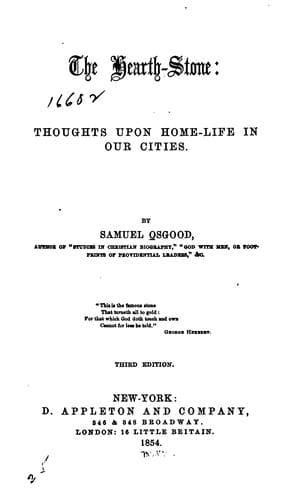
The Hearth-Stone: Thoughts Upon Home-Life in Our CitiesOsgood, Samuel
Religion
The Hearth-Stone: Thoughts Upon Home-Life in Our Cities
Osgood, Samuel
Christian life; Conduct of life
womanhood, and early Christian antiquity is full of traces of the tender
and beautiful affection felt for her, before superstition seized upon the
lovely sentiment and hardened it into a priestly dogma. Yet under the
dogma, the true feeling has never been wholly lost sight of, and with many
who are called idolatrous, the homage to St. Mary is but an exalted form
of reverence to a moral loveliness, now in heaven. Our own Germanic
ancestors shared more deeply in the sentiment probably than any other
people, as they came from their cold homes in northern Europe--received
the gospel of Christ from the missionaries of the church, and rejoiced to
find their national feeling of chivalrous respect for woman confirmed and
spiritualized by the honors paid to her, whom angels hailed as full of
grace, and whose name all Christendom spoke with blessing. This high
sentiment, somewhat sobered by our Protestant faith and our household
utilities, has come to us with our religion and our homes.
* * * * *
It is becoming a somewhat practical, and in both hemispheres, an agitating
question, how far the accepted Christian idea of true womanhood should be
enlarged or amended to meet the demands of our own age. The voice of Mary
Wolstoncroft, claiming masculine freedom for sex, has found a thousand
echoes, and assemblies of women, no strangers to Christian culture, clamor
for a new day of social and political emancipation. Their demands are not
to be treated with ridicule, for under all their extravagance lurk truths
of momentous import. Who can think of the thousands and hundreds of
thousands of the sex, whose utmost labors hardly keep off cold and
starvation--of the wretched notions of education and life, which so
enfeeble the poor and corrupt the affluent--of the false social system
which is so ready to smile upon the destroyer of innocence, and curse the
victim of his arts; who can think of the scenes in the hovels of innocent
poverty, the dens of loathsome vice, and the gilded saloons of painted
misery, upon which the shadows of this blessed eve are now falling, and
not be willing to pardon some thing to the spirit of mercy, even if its
tones seem to us too shrill for gentle lips? Who is not willing to
remember, moreover, that if they assert a folly, who claim for woman the
political offices that must rob the home of her fidelity; they assert, and
actually are diffusing a more dangerous error, who in more silken speech
brand the household virtues as servile drudgery, and whose lives are a
continued and studious round of elegant and jewelled vagrancy from the
sacred uses and blessed companionships of their own fireside; nay, whose
eyes seem only to open when the lights of the theatre and ball-room blaze,
and whose pulses really beat only in exciting assemblies under the
delirium of the wine-cup and the voluptuous dance. From both errors the
true idea of womanhood may save our time, and, nevertheless, confer upon
Public-domain text, read in full here on John Shaqi.
Reviews
Reviews
No reviews yet
Be the first to share your thoughts on this work.
Join the Discussion
Join the discussion
Sign in to leave a comment or review.
Sign InorCreate an account