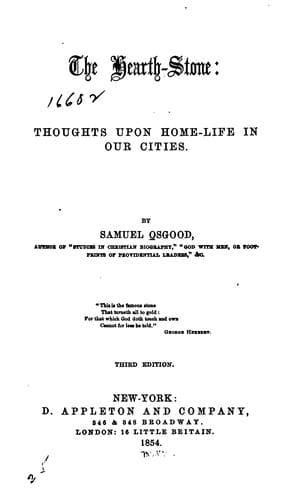
The Hearth-Stone: Thoughts Upon Home-Life in Our CitiesOsgood, Samuel
Religion
The Hearth-Stone: Thoughts Upon Home-Life in Our Cities
Osgood, Samuel
Christian life; Conduct of life
Faith--the faith that God is Father of men--that he is in Christ, and
through Him will visit us in the soul and the life, makes all things
new--constantly leads us into new experience of Divine truth, and makes
old things appear in a new light. This is no narrow creed for the recluse
or the mystic. It is for men of all tempers and conditions. Nay, they need
it most, whose pursuits are most likely to chain them down to the earth.
For them indeed occasional leisure and recreation has no small solace.
But, the best solace for world-weariness is the rest of the soul in God;
the mind's trust in the greatest of realities, the Being of beings. All
pleasure that deadens this trust but adds to the weariness which it would
charm away and is the serpent's whisper, that promises the peace which
comes only from the heavenly dove. Above all our prudence, all our labors
and expedients, we are compelled to look for the true light. Revive,
increase our faith, and straightway all things are new. God reveals new
features of his Providence, and things familiar have a new expression, and
speak no longer only of the earth.
* * * * *
Who can recur thus to first principles and find from them better light and
peace, without carrying the renewing influence into the sphere of the
affections? Here the Divine Word has a voice for us--a voice too much
neglected because identified either with a perplexing theological system
or a shallow sentimentalism. God is love, and he that loveth not knoweth
not God. This truth came from Him who made the soul, and knows well its
wants. Bring it near to us and feel its renovating power. There seems
always indeed to be a peculiar peril in moralizing upon the affections,
and they are very apt to be chilled by the precepts that most insist upon
their vitality and warmth. But the Christian Gospel is little disposed to
waive its imperious claims from fear of the metaphysician or the
sentimentalist. It says Love God and the brethren, and bids us make this
truth practical. As the years pass, instead of having less affection, we
ought to have more. A true life always has more, as it enlarges its
experience and its faculty--not indeed more of that superficial
sensibility which is the burden of so many moon-struck rhymesters and the
great staple of the common romancers, but more of that divine charity,
that vital good-will, which holds filial communion with the Father, and,
striving to be perfect even as he is perfect, carries the light and warmth
of its presence into every sphere of life. In fact, the highest human
wisdom is affectionate as it is mature. The novice in thought may be sharp
and crabbed, but the sage is tolerant and kind. He who sees the truth in
its reality, sees that it is the form which contains and expresses
goodness. If there be a kind of intellectual power that is bitter and
malicious, it is sure to be only some shape of low cunning or some
Public-domain text, read in full here on John Shaqi.
Reviews
Reviews
No reviews yet
Be the first to share your thoughts on this work.
Join the Discussion
Join the discussion
Sign in to leave a comment or review.
Sign InorCreate an account