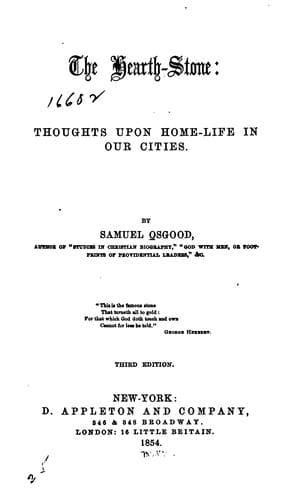
The Hearth-Stone: Thoughts Upon Home-Life in Our CitiesOsgood, Samuel
Religion
The Hearth-Stone: Thoughts Upon Home-Life in Our Cities
Osgood, Samuel
Christian life; Conduct of life
holier and lovelier tribute to friendship than in the offering which in
our utilitarian age the genius of Tennyson has laid on the tomb of Arthur
Hallam? These are great instances indeed, but they speak what all may
feel. Nay, what is the secret of the power of the poet or sage, except
that he can best say what comes home to us all?
Friends,--We have and must have some whom we call such. Happy are we if
they can be truly so called. It is not for us to choose, whether we shall
have friends at all or in any sense, but it is ours to choose, whether we
shall have them in the right sense. All people, however depraved, will
have some associates whose company they to some extent enjoy, and he who
cares for nobody and for whom nobody cares, may be set aside from the
human family as essentially monstrous. Of monsters we are not treating,
but of men, and with our common nature in view, I speak now of the duties
of friends.
* * * * *
This relation is founded in the will of God and the being of man. God has
made us dependent upon each other for protection and comfort. The
dependence is not limited by family ties alone, but extends to a large
circle, in some measure indeed to all with whom we deal or speak. Nor is
it confined to material interests. Friendship is as much a moral fact
under Providence as light or gravitation is a physical fact. We like to
see and talk with people for the pleasure of their society, and are
unhappy when long away from those we know best. God has made this to be so
in the structure of our nature, and His work as Creator has been
constantly carried out by His providential care for society and all its
affinities.
Our need of friends shows His designing will, and His designing will is
all the clearer as this need is well supplied. In fact, we cannot be truly
ourselves without society. Our thoughts and feelings cannot fully come out
apart from congenial companionship. It cheers us, it quickens our powers,
stirs our purposes, and the very best things that have been done in the
world prove its worth. Christ himself needed it, rejoiced in it,
consecrated it. As His disciples went forth two and two to found the
heavenly kingdom, the social element kept company with the religious in
their own hearts, and in their creed. The divine charity which the gospel
inspired, cherished personal friendships as well as general humanity. The
grim hermit, in an age whose faith gloried in sacrificing companionship to
piety, was glad to know that other persons like himself were in the same
wilderness, and would have been frantic at the very idea of being the only
person living in the world. His lonely cell was many a time lighted up by
images of friends still loved.
Public-domain text, read in full here on John Shaqi.
Reviews
Reviews
No reviews yet
Be the first to share your thoughts on this work.
Elsewhere in the archive
Join the Discussion
Join the discussion
Sign in to leave a comment or review.
Sign InorCreate an account