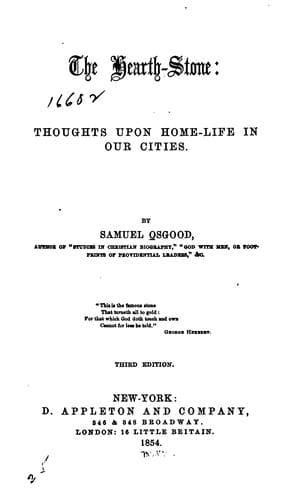
The Hearth-Stone: Thoughts Upon Home-Life in Our CitiesOsgood, Samuel
Religion
The Hearth-Stone: Thoughts Upon Home-Life in Our Cities
Osgood, Samuel
Christian life; Conduct of life
A freer age has brought out anew the friendship of the gospel, and little
as enlightened people nowadays may be inclined to put on the dress and
phrases of the Quaker, there has probably never been a time when so many
accepted the essential ideas which led George Fox, William Penn and their
associates to reject the old names and forms, and call the Christian
Church simply a society of friends. There is a kindly feeling over the
world now, and much of the best hope of humanity rests upon the fact, that
so many judicious and influential people of every land know each other
pleasantly and wish each other well. So friendship even in this sinful
world is showing God's will for us, bringing out our own faculties and
fulfilling the divine plans for mankind.
* * * * *
The sentiment, that animates the relation, needs little definition or
analysis. In some sense, all understand it, although its best sense a
true life only can teach. They are friends, who are attached to each
other, with any kind of liking or loving. The attachment may begin in
interest, as with parties in business or in pleasure, as with the votaries
of some art or science, and as the interest or the pleasure is low or
elevated, the attachment will shape its character. But however it begins,
it never continues well and becomes genuine, unless the parties stand upon
the same platform of principle, agree in what is highest and best, and in
some way come within the scope of the Master's sense of a true friend,
when he said, "I have not called you servants--I have called you friends."
Undoubtedly they are the best friends who differ much in incidental traits
and agree in the essentials of character. Their likeness and their
unlikeness brings them together. Their likeness makes them congenial, and
their unlikeness makes them instructive and interesting to each other.
Herein they follow the law of elective affinities, that runs through
nature, and which makes a certain contrast essential to true harmony.
Elective, yet not exclusive or entire, as the relation is, friends choose
each other freely without ties of kindred blood, and however cordial the
choice may be, it does not imply exclusive regard or entire union of
interests. Affection, as well as esteem, enters into the sentiment, but in
comparison with relations of blood and marriage, the element of esteem is
generally larger in its composition than that of affection. It is esteem
growing into affection rather than affection growing into esteem.
Come now to the practical point of view, and consider the duties of
friends for ourselves. We have and desire to have friends, those who are
such in general and those who are such particularly. What are we to do to
keep or make them?
Public-domain text, read in full here on John Shaqi.
Reviews
Reviews
No reviews yet
Be the first to share your thoughts on this work.
Elsewhere in the archive
Join the Discussion
Join the discussion
Sign in to leave a comment or review.
Sign InorCreate an account