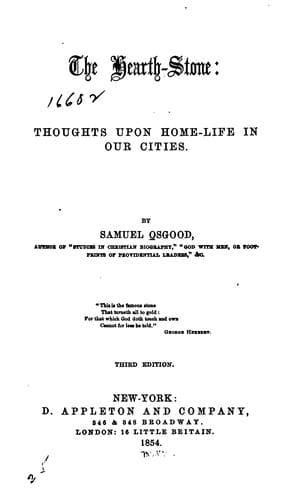
The Hearth-Stone: Thoughts Upon Home-Life in Our CitiesOsgood, Samuel
Religion
The Hearth-Stone: Thoughts Upon Home-Life in Our Cities
Osgood, Samuel
Christian life; Conduct of life
It is the law of God certainly, that there should be inequalities of
gifts, and from these diverse gifts, whether of talent or opportunity or
both, come varieties of place and influence. There is no such thing as
perfect equality in the universe, except in the mathematician's calculus,
or the metaphysician's theory. Neither God nor man has ever made two
things exactly alike, and the diversity that appears between two blades of
grass from the same stalk, or two needles from the same mechanism, is of
course greater as we rise in the scale to creatures, so various and
complex in faculties and discipline as mankind. Think not, however, that
this inequality favors pride on the one hand, and sycophancy on the other.
The Creator has more wisely adjusted the checks and balances of his
government. In some respects, he has made every man dependent upon his
fellows. The greatest sage needs to learn something from the peasant, and
to receive much from his toil. The king must serve the country which he
professes to rule, and the best wisdom of his counsellors must serve the
throne. The merest glance at society round us shows an endless gradation
of varied service. The ablest lawyer is quite as much bound to devote his
talents to his client's cause, as his client is bound to requite his
labor. The merchant prince, creditor to many, has creditors also of his
own. He that is called in the Lord, being a servant, is the Lord's
freeman; likewise also, he that is called, being free, is Christ's
servant. In some sense, then, every man is a servant, and in some sense,
too, every servant is a master, or in something commands.
Is not this arrangement well? The fact that it is so essential to the
Divine government would prove this; but can we not see its good fruits?
The difference of relation calls out the various faculties of our being,
and life, like nature itself, teaches us to use our eyes and minds by
looking and striving above, below, and around. If we would bring out the
skill and strength of the hand, we must lift up, as well as hold on, and
so, by dealing with things high and low its muscles are pliant and strong.
It is the same with all our powers, and there is no man, who is thoroughly
educated or brought out, who does not obey as well as command. The motto
of the Black Prince, "Ich Dien," "I serve," is written on every true man's
standard, and no man is fit to rule who has not learned to obey.
Public-domain text, read in full here on John Shaqi.
Reviews
Reviews
No reviews yet
Be the first to share your thoughts on this work.
Elsewhere in the archive
Join the Discussion
Join the discussion
Sign in to leave a comment or review.
Sign InorCreate an account