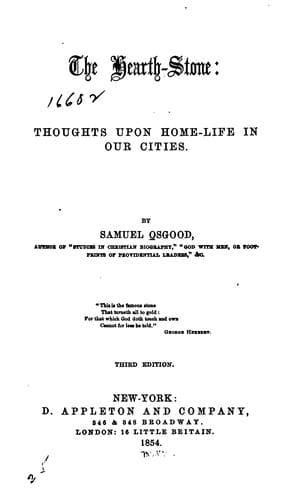
The Hearth-Stone: Thoughts Upon Home-Life in Our CitiesOsgood, Samuel
Religion
The Hearth-Stone: Thoughts Upon Home-Life in Our Cities
Osgood, Samuel
Christian life; Conduct of life
Society in all ages, and especially in our own, has been testing this
truth, and nothing is more obvious now than the general striving after a
truer adjustment of mutual service. It haunts us at every turn. In the
topic of work and wages, it is the problem of the political economist,--in
the relation of people and ruler, it agitates every government on
earth,--in the question of master and servant, it comes home to every
family. Our position towards it now is a very simple and practical one.
Carrying out our plan of treating home duties, we come now to the
treatment of inferiors, especially those of our own household, or the
relation of masters and servants.
* * * * *
We start with a clear principle, that defines at once the sentiment that
belongs to this relation. Both parties have the same essential nature, and
we use the term inferiors simply as denoting the fact of service, and the
attendants of that fact. The servant may be, and often is, a better man
than his master--sometimes a wiser one. Yet his position, in a very
obvious sense, is inferior, and whilst having privileges of his own, he
is subject in his sphere of service to his master's orders. This
subjection implies no surrender of moral dignity. The service should be
given as from man to man, and so received; and the difference of position
affects the office, and not the moral worth of the parties. Even the bond
servant, according to St. Paul, is not to be deprived of his moral
dignity, but is to be treated as under God a serving brother. As much as
this is asserted now by the moralists of slavery, such as Dr. Thornwell
and his school, who maintain that purchase does not make the buyer owner
of the slave, but merely of his labor. Surely less than this position,
which is so speciously assumed to justify bond-service, should not be
allowed to the servant who is freely such. Let the service be what it may,
and implying whatever lowliness of gifts, so long as it can be honestly
rendered, it implies no degradation; and a good servant is morally to be
respected as much as his master. Premising this, and remembering that
whatever is said of one kind of service has a bearing upon all kinds, we
are ready to look practically upon the duties of the relation.
* * * * *
Public-domain text, read in full here on John Shaqi.
Reviews
Reviews
No reviews yet
Be the first to share your thoughts on this work.
Elsewhere in the archive
Join the Discussion
Join the discussion
Sign in to leave a comment or review.
Sign InorCreate an account