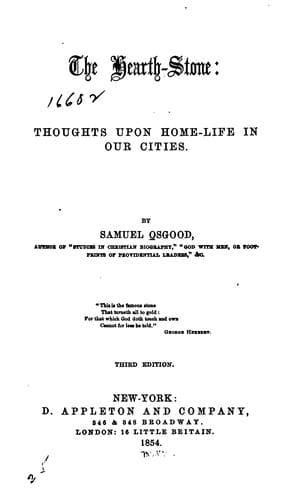
The Hearth-Stone: Thoughts Upon Home-Life in Our CitiesOsgood, Samuel
Religion
The Hearth-Stone: Thoughts Upon Home-Life in Our Cities
Osgood, Samuel
Christian life; Conduct of life
It is most profitable for us, in addressing a community who employ so many
people in their homes and business, to treat the subject chiefly as it
bears upon masters or employers, although in doing this the duty of
servants must needs be implied. This is implied, certainly, in the
position which we lay down at starting, when we say, that it is the
master's duty first of all, to have in himself the fidelity which he
requires from his servant. Here both parties meet, and are called to be
trusty. The best examples and the plainest reasonings establish this
ground. Does a great commander, like Washington, send an officer or
soldier upon some difficult expedition, he asks of his inferior to be true
to the principle which he accepts, and his whole tone and manner says, "I
serve the country in my way, and so do you under my orders and in your
way." Our Saviour himself cherished the very allegiance which he required
of his followers; nay, he grounded its obligation upon the very nature of
the Divine mind, when he bade them work, while it is day, and said, "My
Father worketh hitherto, and I work." Whenever a master or employer takes
lower ground than that of mutual trust, he puts himself below his servant.
If he professes only to follow his own caprices, and yet asks his servant
to be faithful, he exacts fidelity, whilst he cherishes caprice, and so in
the moral scale takes a place below his inferior.
He thus fails of setting the true example of trustiness to his servant,
and of having, by due fellow feeling, proper consideration for him. He is
like the harsh creditor in the parable, who, having first been a reckless
defaulter to the king, after having begged forgiveness for the enormous
debt of fifteen millions, turned at once upon his poor fellow-servant,
took him by the throat, and had him cast into prison for the paltry sum of
about fourteen dollars. He was a treacherous man, and so could neither
reasonably demand fidelity, nor have fellow feeling for honest misfortune.
His lot is due to every man who repudiates his solemn responsibility to
God and his neighbor, yet insists upon utter deference from those beneath
him in a capricious tyranny, which is far beneath faithful service. Every
household should learn the lesson, and wherever its most favored members
do not feel the solemn obligations of life, and live for objects beyond
their own caprices, they are rebuked by their very exactions, and should
be shamed by the very fidelity they ask. A true family will set this
matter right by teaching practically, that no wealth, nor station, nor
elegance, nullifies responsibility, and its daily method will prove that
the doctrine of stewardship is accepted in parlor and chamber before it is
preached to the basement and attic. In fact, no true man will be content
with being less useful than his servants, and certainly many an affluent
and high-minded master meets an amount of responsibility, and does an
Public-domain text, read in full here on John Shaqi.
Reviews
Reviews
No reviews yet
Be the first to share your thoughts on this work.
Elsewhere in the archive
Join the Discussion
Join the discussion
Sign in to leave a comment or review.
Sign InorCreate an account