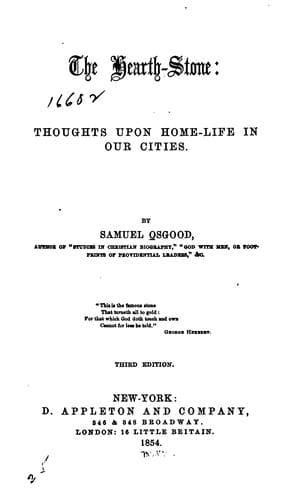
The Hearth-Stone: Thoughts Upon Home-Life in Our CitiesOsgood, Samuel
Religion
The Hearth-Stone: Thoughts Upon Home-Life in Our Cities
Osgood, Samuel
Christian life; Conduct of life
Nor should this regard for the character of servants end in mere
negations. They should have the positive influence of a Christian temper
in the family, and, when arbitrary creeds do not prevent it, they should
have liberty to be present at such family devotions as may be held for the
edifying of the household. So do we interpret justice in this relation in
its bearing on fortune and character. Some might think our view very
defective, from leaving out the element of entire social equality. If by
this be meant a recognition of the moral worth of faithful servants, we
make the recognition, and deem them the equals of all whom they equal in
character. But, if social familiarity be the test of equality, it is
answer enough that this is a matter of congeniality or elective affinity,
and nothing could be more arbitrary and unjust than to force persons into
a familiarity for which their education, tastes, and labors disqualify
them. Such a course would comport as little with justice as with mercy.
Mercy,--rest upon that word. We have said that both parties should be
trusty, and have urged justice upon the master especially. We now add,
that he should merciful.
We are all frail and erring, and need great forbearance for ourselves. Why
be unwilling to bestow it on the less favored? We all make some mistakes,
and how can we expect the less intelligent to be freer from error? Why be
irritated if every thing is not done precisely to our liking? They that
forbear threatening may win better service by that fact, for nothing so
provokes carelessness and disheartens effort, as the impatience that
regards a mistake as a crime, and brands an oversight as an insult.
We ourselves are variable in health, spirits and energy, and must make
allowance for the like variation in persons probably less disciplined than
ourselves. We may show due consideration without fickleness, and kindness
without familiarity. Cruel, indeed, is the wrong that confounds the
fidelity that is struggling to do well in spite of temporary illness, with
the idleness that wantonly neglects any well-known duty. Some misgivings
very kind people may reasonably have in regard to servants in feeble
health; and the Christian charity of a community will continue very
deficient until they, who render faithful service, are cared for better in
private houses or proper institutions in seasons of sickness.
Upon this subject we are apt to speak too arrogantly when we contrast our
domestic manners with those of persons burdened with bond servants, and to
call him as of necessity a tyrant who may be more than ourselves a
protector. In our just condemnation of slavery, remember that much
kindness lightens its bonds; and, remembering too, the millions of dollars
in legal property which masters have relinquished, when we preach, as we
may justly do, stern self-sacrifice to others, learn well that the duty of
caring for inferiors has applications quite as solemn under a Northern as
under a Southern sky.
Public-domain text, read in full here on John Shaqi.
Reviews
Reviews
No reviews yet
Be the first to share your thoughts on this work.
Elsewhere in the archive
Join the Discussion
Join the discussion
Sign in to leave a comment or review.
Sign InorCreate an account