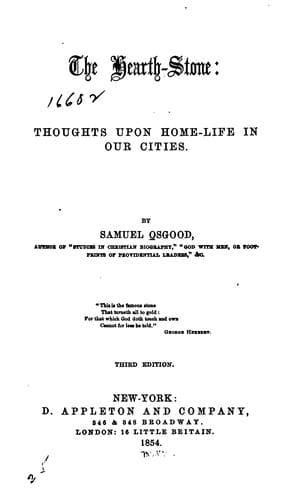
The Hearth-Stone: Thoughts Upon Home-Life in Our CitiesOsgood, Samuel
Religion
The Hearth-Stone: Thoughts Upon Home-Life in Our Cities
Osgood, Samuel
Christian life; Conduct of life
It is common, I know, to talk of the ingratitude of inferiors and the
thanklessness of mercy. Alas! there is enough in our own hearts to justify
misgivings, and when we think how ingrate we are, we may look more with
pity than bitterness upon the indifference with which so many receive
favors, sometimes making their very constancy the plea of insolent demand.
Nevertheless, mercy will not be without reward, and, in due season, will
penetrate with its own spirit minds sadly blunted by harsh usage. Hand in
hand with judgment and rectitude, it will win here below the promised
blessing, and obtain its own beatitude for its giver.
Mercy,--what is it but humanity--love in its downward look, the look with
which Jesus went about among men? Looking thus downward, the soul sees a
verdure, and rejoices in a genial light and warmth not found in any proud
star-gazing: for the best blessing of heaven is reflected upon its lowly
gaze. Mercy,--he who comes short of it, comes short of his neighbor and
his God. It is the ground of all devotion. The home where it dwells not,
dwells without God in the world. More than can be expressed in any act, we
need it; even an abiding sentiment, broad as our race, deep as our need.
Looking upon a criminal, a blunt preacher said; "There goes John Newton,
but by the grace of God." Says an old divine: "Well may masters consider
how easy a transposition it had been for God to have made him to mount
into the saddle that holds the stirrup, and him to sit down at the table
who stands by with the trencher." Looking upon our inferior any where, let
us have something at heart which says: "Friend, brother, true I am better
off in this world's goods than you, but whether fortune or desert has made
the difference, that fact does not decide, and, whether deserved or
undeserved, my superiority teaches humility, not pride--responsibility,
not arrogance."
Review now the course of meditation upon the more direct home duties. We
treated of ties of nature in speaking of parents, children, brothers and
sisters; of ties elective in speaking of husbands and wives, friends; and
now we add the last class of elective ties, by passing from relations of
equality to that of master and servant. We have cherished through these
pages a degree of home feeling together, and in some points our various
experiences must have accorded. Such subjects cannot be treated with any
sort of fidelity, without touching some deep convictions and sacred
remembrances. They have solemnity and also cheerfulness, telling of vast
privileges to impress momentous duties.
Public-domain text, read in full here on John Shaqi.
Reviews
Reviews
No reviews yet
Be the first to share your thoughts on this work.
Elsewhere in the archive
Join the Discussion
Join the discussion
Sign in to leave a comment or review.
Sign InorCreate an account