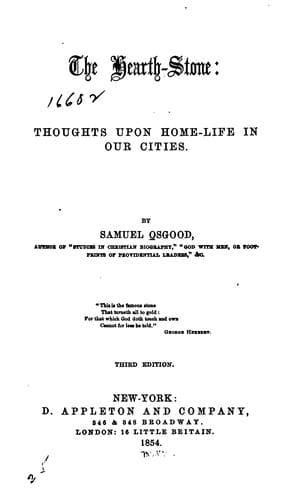
The Hearth-Stone: Thoughts Upon Home-Life in Our CitiesOsgood, Samuel
Religion
The Hearth-Stone: Thoughts Upon Home-Life in Our Cities
Osgood, Samuel
Christian life; Conduct of life
Thus onward do we go,--not alone, but with companions, superiors, equals,
inferiors--all giving and taking influence; if we will have it so, God
with us through all and in all. If superiors inflame ambition, let them
teach respect; if equals make our enjoyment, let them move our good will;
if inferiors tempt our pride, let them kindle our benevolence. We cannot
cherish this spirit in vain. A kindly heart will win from the lowly many a
blessing, and develope many a power. Among the thoughts that give peace to
a man's dying pillow, none will be sweeter than the remembrance or image
of those whose lowly condition he has bettered, and asked no reward of the
world. Since Christ has lived, rich indeed has been the heavenly treasure
laid up by such compassion towards those who bear the world's heavy
burdens and have few of its smiles. Forgetting them, we forget our
Saviour, who made their cause so his own, and we repudiate our share of
His blessing upon the faithful servant!
The Divine Guest.
THE DIVINE GUEST.
The long rainy season was over, the roads once more were settled, and the
happiest festival of all the year joined with the charms of Spring to draw
the Hebrew people toward their sacred city. Nowhere in the whole land was
there more to cheer the eye than in the beautiful town through which the
festal caravans from the north were now passing on their way to the
Passover. Jericho was called "the City of Palms," from the profusion of
those stately trees in its fertile valley. These now added spring blossoms
to their evergreen foliage; the sycamore was beginning to give cheering
promise of its figs, and the balsam-tree, whose gum was worth twice its
weight in silver, was showing its scanty and precious bloom in the walled
gardens, whose wealth Mark Anthony gave to Cleopatra as a fit gift from a
conqueror to a queen. The people were astir with the excitement of the
season, as the travellers began to pour into the city. Soon word went
round that the noted prophet, Jesus of Nazareth, was approaching, with a
large company about him. The wonder grew, as the report of a great miracle
upon the blind Bartimeus went from mouth to mouth. The fever reached into
quarters not abounding in Jewish enthusiasm, and quickened the calmer
blood of the revenue officers of the Roman government. The chief of them
went out to get a glimpse of the famous preacher, whom so many hailed as
the long-expected Messiah. The rich publican, being a man of small
stature, and, from his political relations, not likely to receive much
civility from the crowd at such a time, climbed up into a sycamore
fig-tree, whose spreading branches probably overhung the street. If seen
at all by the populace it was with little favor, for they hated alike his
connection with Rome and his lax, or, perhaps, his enlarged views of the
Jewish creed. To the surprise of all as much as himself, the publican is
singled out by the Messiah from among them all in the words: "Zaccheus,
Public-domain text, read in full here on John Shaqi.
Reviews
Reviews
No reviews yet
Be the first to share your thoughts on this work.
Elsewhere in the archive
Join the Discussion
Join the discussion
Sign in to leave a comment or review.
Sign InorCreate an account