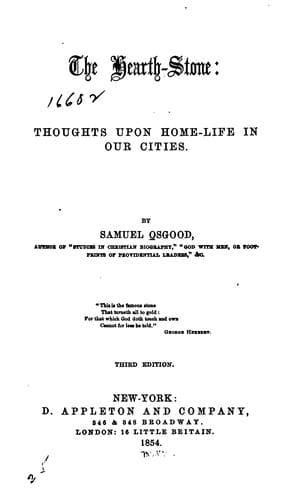
The Hearth-Stone: Thoughts Upon Home-Life in Our CitiesOsgood, Samuel
Religion
The Hearth-Stone: Thoughts Upon Home-Life in Our Cities
Osgood, Samuel
Christian life; Conduct of life
"Thy house!"--still nearer the appeal is brought by this expression. "Thy
house!" "I will go home with thee," says the Master always in his Word,
and his search-warrant has never lost its power. There is something in
every heart that shrinks from public gaze, and every family justly
cherishes the privacy of the household. But God, if he sees us any where,
sees us there, and we reverence Him, as we receive His Word as our
household guest. There can be no serious faith or purpose until we come to
this, and are ready to take religion home with us. It will very likely
show things in a new, and sometimes startling light. We may, perhaps, pass
a tolerably creditable examination, when tested by our manner in street,
or church, or general society. Sometimes the deference of good breeding
may wear the look of inherent kindness, and refinement of address may seem
like spirituality of character. It was a severer trial for the publican,
"To-day I must abide with thee," than the mere summons to "Make haste, and
come down."
* * * * *
It is a trial that we must all undergo the moment we begin to think
seriously for ourselves; a trial, too, that cannot be shunned without
losing the best blessings of life. Let the household be examined according
to the standard, which we do honestly regard as reasonable and religious.
What are the household gods? We have not, like the Romans, the custom of
setting up images in our homes, and keeping a votive flame always burning
before them. Yet the sentiment which the Roman custom expressed, we must
in some way entertain. Every household has its idols, the emblems of its
faith or infidelity. It has many associations peculiar to itself, and
makes its own choice moreover among the associations that prevail in the
neighborhood, or world, or age. It has its own Manes, or its especial
remembrances of the departed;--it has its Lares, or favorite family
standards;--it has its Penates, or its own selection from the idols or
authorities of the people. These influences exist in the highest home and
in the humblest--are to be traced in the old nobilities, whose caste,
party, and creed, are fixed by the allegiance of a thousand years, and in
the unpretending villager who thinks himself highly favored in ancient
lore, as he reads in his family Bible the name and birth of his
grandfather. Nor are the same influences wholly wanting to those who wish
to repudiate their ancestry, the spendthrift upstarts of fortune, whose
crest, manufactured to order, is but an attempt to hide the only honorable
fact in the family history, that one ancestor was a plain, industrious
man, with energy enough to earn by his trade the wealth that heirs
squander in folly. Generally, it needs little antiquarian study to learn
the ruling genius of the house. It is not only in the house of Atreus or
Oedipus, or in the line of the Stuarts and the Bourbons, that family
Public-domain text, read in full here on John Shaqi.
Reviews
Reviews
No reviews yet
Be the first to share your thoughts on this work.
Elsewhere in the archive
Join the Discussion
Join the discussion
Sign in to leave a comment or review.
Sign InorCreate an account